For most of the industry’s history, the storage customer was someone in motion. They were selling a house, relocating for a job, or stuck between leases. Storage was the bridge between one home and the next.
That customer hasn’t disappeared, but they’re no longer the whole story. Home sales have been stuck near historic lows for three years, people are moving less, and a growing share of renters are using storage for a different reason: they need more space than their home provides.
When demand is soft, the customers already in your units become your most important audience.
In this post, we’ll look at the data behind the change in renter behavior and why it makes length of stay one of the most important numbers operators should be watching right now.
Short answer: the housing market. Existing-home sales ran at a seasonally adjusted annual rate of 3.99 million in September, and sales have hovered around a 4 million pace since 2023. That’s well short of the roughly 5.2 million homes that change hands in a normal year. NAR’s chief economist called August and September the two slowest months for home sales this year, and pending sales fell 11.3% year over year.
Since moving has always been a fundamental reason people rent storage, that slowdown shows up directly in your move-in numbers. According to Storable’s Q3 2026 Industry Pulse, which tracks more than 30,000 facilities, move-ins were down 5.7% year over year. Move-outs fell too, by 4.0%, which is a big part of this story.
Pricing reinforces the narrative. Even with less new supply coming online, Yardi Matrix reports that national advertised rates have been below the prior year every month since spring.
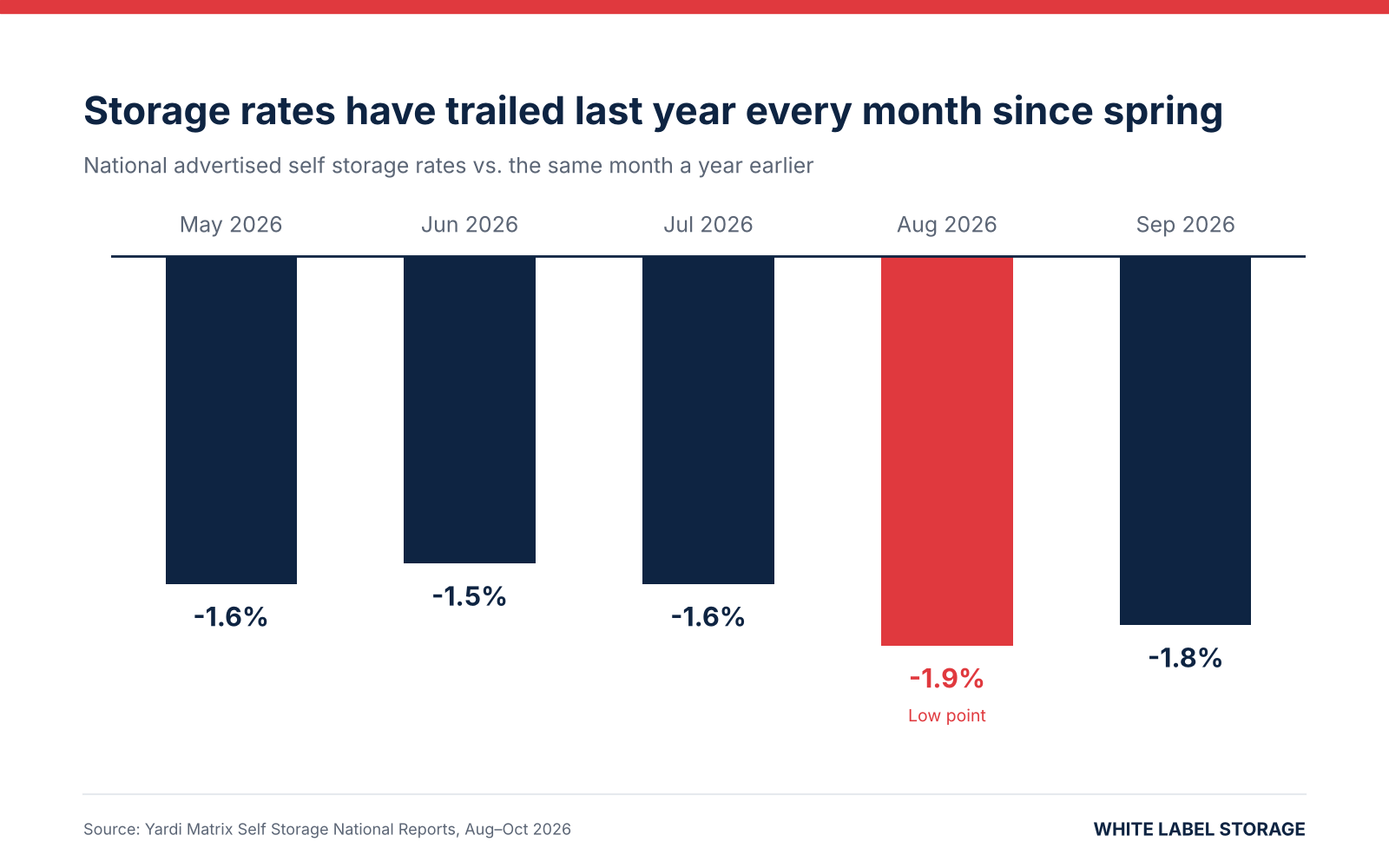
The REITs are cutting hardest. In September, their asking rates were down 3.3% year over year compared with 1.0% for non-REIT operators, and Yardi interprets those deeper cuts as a possible sign that recent demand has weakened.
An influx of new supply has played a large part, but in essence, there are fewer new customers to go around, and the biggest players are fighting hard for them.
Even as moving slows down, people still need storage. But their reasons have changed.
In StorageCafe’s 2026 self storage survey of 1,430 Americans, not having enough room at home was the single biggest reason people rent a unit. It showed up in 34% of homeowner responses and 31% of renter responses. Moving came in second, at 20% of homeowner responses and 30% of renter responses.
This trend has become more pronounced in recent years. StorageCafe has asked current storage customers about their primary reason for renting for years, and lack of space has led the list in each of its last three reports.
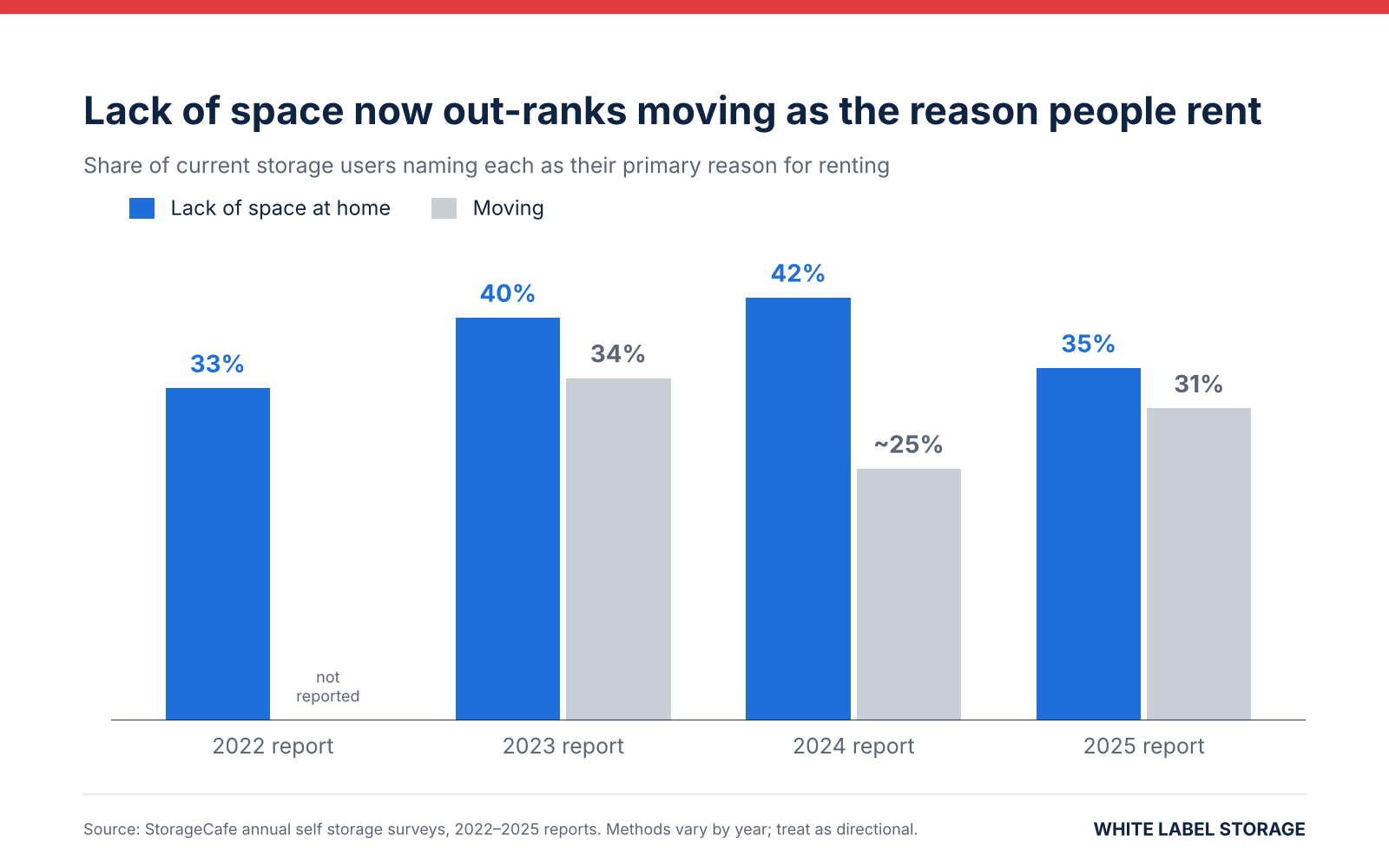
The 2024 report also found that moving was the reason that dropped the most, falling from about a third of respondents to a quarter. StorageCafe tied this trend to a slowdown in migration across the US.
*StorageCafe changed how it reported the question in 2026, so that year’s numbers aren’t directly comparable, but lack of space still came out on top.
Several forces are coalescing to cause this change in behavior:
The result inverts a long-held truth in the industry: customers now rent storage because they’re not moving. Storable’s survey found that 16% of Americans have already rented storage specifically because they can’t move to a home that fits their needs, and another 25% are considering it.
The big operators are seeing the same thing in their own customer base. On its Q2 2026 earnings call, Extra Space Storage said the share of customers storing because they lack space has gone up as the share of moving-related customers has declined.
A mover needs a unit until the new house closes or the new lease starts. Their need has an end date. Someone who’s run out of room doesn’t have one.There’s no natural reason to move out.
That difference is starting to show up in the numbers. Storable’s Q3 2026 Industry Pulse found that the average length of stay reached 19.0 months, up 1.1 months from a year earlier. Earlier in the year, Storable’s Q1 report put it at 19.3 months, up from 18.1 months the year before.

That’s why occupancy has held up even as move-ins dropped. Storable put national occupancy at 78.1% in Q3, up slightly from a year ago, and Yardi Matrix’s Doug Ressler told StorageCafe that recent occupancy gains have come more from fewer move-outs than from stronger move-ins.
While the share of space-driven renters is rising and average stays are rising at the same time, no industry source has directly measured how much longer a “lack of space” tenant stays than a mover.
There is good reason to believe a casual relationship exists between the two trends, but at this time it is inferred. Storable itself frames it as a likelihood, noting that someone who needs more room at home may stay longer than someone storing during a move.
Here’s why length of stay deserves a spot next to occupancy on your dashboard:
Storable pegged the average 10x10 move-in rate at $109.33 in Q3. At a 19-month average stay, a single 10x10 rental at that rate is worth a little over $2,000 before any rate increases. Every additional month that tenant stays adds roughly another $109, with no marketing spend, no move-in special, and no vacant days in between. When new tenants are harder to find, holding onto the ones you have is often the cheapest revenue you’ll ever earn.
Move-outs are the real reason lease-up stalls. Move-in numbers that look good at zero occupancy, won’t be enough to prevent a plateau further down the line. But increasing length of stay fundamentally alters the numbers of move-ins you need per month to hit stabilization.
Read our article on why lease-up stalls to get the full breakdown.
A tenant who stays 19 months goes through more existing customer rate increase cycles than one who stays six. That’s a big opportunity. But Ressler also notes that today’s customers are more price sensitive, and affordability was the top facility feature in StorageCafe’s survey.
Pushing too hard can cut short a stay that might have lasted years. Even Extra Space said it gives some level of relief to about 16% of customers who receive a rate increase to keep them in place.
New construction is slowing. Yardi reports that space under construction now equals just 2.1% of existing inventory. As we covered in How Slowing Storage Development Could Benefit Operators, fewer new competitors gives existing facilities more room to hold rates. But that benefit only shows up if you’ve kept the tenants you already have.
The storage customer is changing. Fewer people are renting because they’re between homes, and more are renting because their home no longer fits their life. Those tenants tend to stick around, and in a market where move-ins are down and rates are still under pressure, that improvement in customer lifetime value (LTV) is invaluable.
Of course, juggling pricing, retention, and marketing at the same time is a lot, especially if storage is only one part of your business. That’s where White Label Storage comes in. Our 3rd-party self storage management brings together revenue management, a dedicated call center, and digital marketing built specifically for self storage, so you can protect your rent roll and grow it at the same time.
Want to know how your facility’s length of stay stacks up, and what it’s worth to you? Let’s talk.