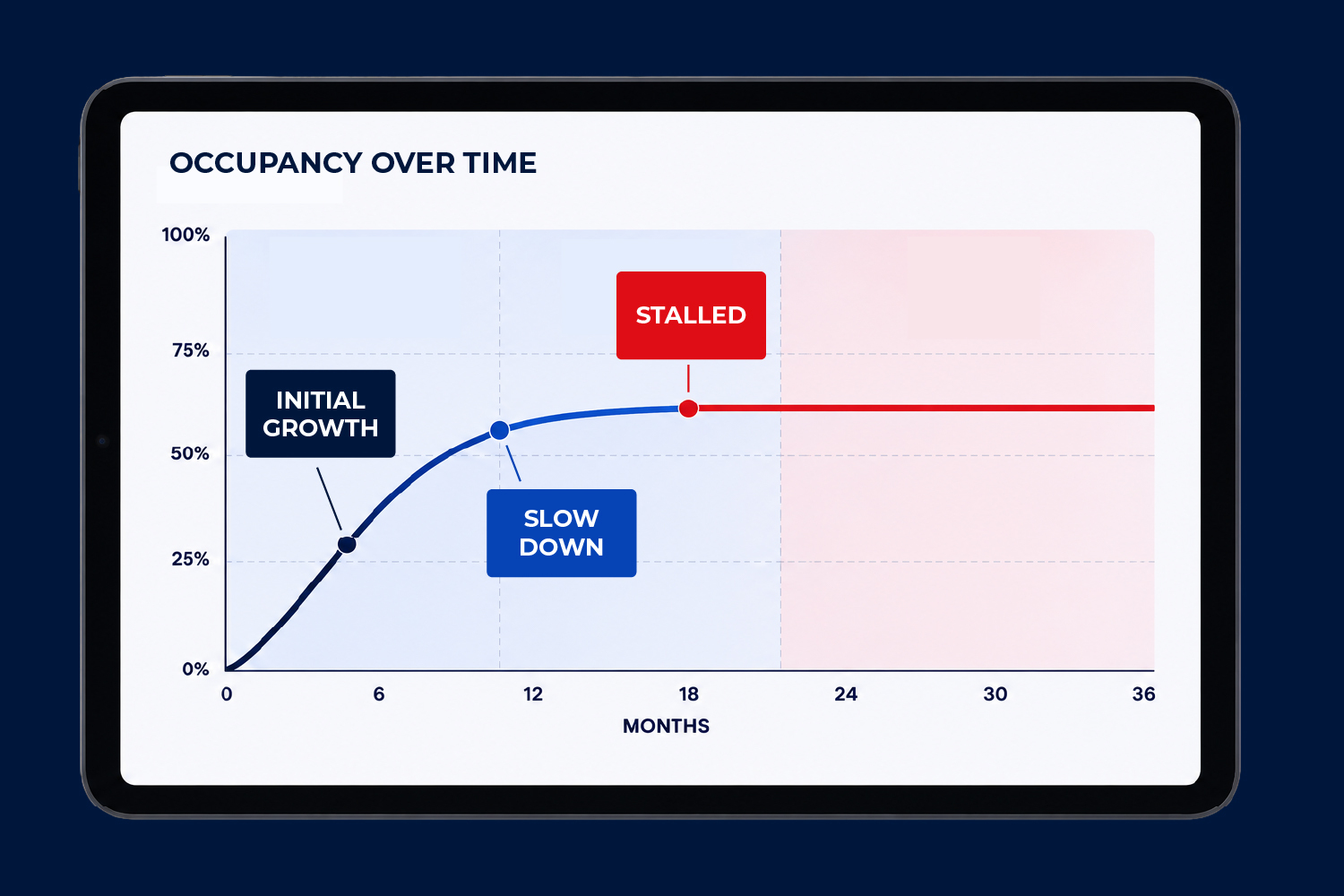

Marketing is the engine of growth for your facility, but without a clear strategy, it can quickly become a drain on both time and budget. Many owners view marketing as a cost center because their tactics are reactive.
Top operators know that sustained, profitable occupancy lies in a coordinated, intentional approach to self-storage marketing.
Instead of relying on disconnected efforts, success comes from focusing on simple, repeatable building blocks. A structured approach ensures that every channel works together to support business goals, eliminating the waste that comes from "random acts of marketing."
In this post, we’ll break down the fundamental self-storage marketing strategies, including how to

Jumping straight to tactics, like placing a Google Ad or boosting a social media post, is the most common marketing mistake we see.
Before you choose a channel, you must define what success looks like for your facility. For self-storage, marketing is fundamentally a revenue management function. Its core objectives are specific:
However, the resources required to hit those targets depend entirely on your facility's current reality. A new facility in "lease-up" mode requires a significant marketing budget to capture new tenants, while a stabilized facility might only need a modest maintenance budget to keep occupancy steady.
Instead of viewing marketing spend as a flat expense, view it as a variable investment calibrated to your facility's lifecycle. The goal is always to acquire tenants whose lifetime value far exceeds the cost to get them in the door, but the intensity of that spend will shift as your facility matures.

Once you have defined your goals, the next step is understanding your target audience. You need to identify the demographics of the individuals or businesses most likely to require storage in your specific area. Are you catering primarily to homeowners and renters, local contractors, or college students?
To make this actionable, it helps to group these potential customers into buyer personas. This approach moves you beyond generic demographics to understanding the specific triggers and pain points driving their search. This allows you to generate practical self-storage marketing ideas that align messaging with real renter needs.
While every renter is unique, most of your potential customers will more than likely fall into three primary categories, and tailoring your marketing efforts to their specific needs is how you persuade them to choose you:
This is typically the largest segment. These individuals are often downsizing, moving, or needing temporary space during renovations. They are frequently stressed and looking for immediate relief, so they prioritize speed, convenience, and proximity.
Local business owners often require extra space for inventory, equipment, or archiving documents. Unlike residential users, they treat storage as a logistics solution. They care less about "climate control" buzzwords and more about practical features like gate access hours, security, and vehicle clearance.
This group includes students needing summer storage or owners looking for a place to park large items like boats and RVs. Their needs are predictable and driven by the calendar.
By understanding these distinctions, you can align your messaging with demand. For example, a facility near a university should target students with flexible terms in April, while a location in a business district should highlight security for commercial clients.

Once you know who you are targeting, the next step is ensuring they can find you the moment they need space. Since customers rarely browse for storage for fun, your strategy must focus on capturing high-intent traffic exactly when the search begins. In today’s market, that means prioritizing the channels that drive immediate action.
Your website is often the first point of contact, so it needs to act as a 24/7 leasing office. Since most users search on mobile devices, your site must be mobile-friendly and feature a seamless online rental system.
A potential tenant should be able to view real-time availability, compare unit prices, and click a “Rent Now” button to complete the lease in minutes. If they can’t rent online, you will lose them to a competitor who allows it.
For local SEO marketing, having a Google Business Profile (GBP) is crucial. Users often search for terms like "self-storage near me" and go directly to the Maps results. Ensure your profile is complete with accurate contact information, hours, and photos.
Similarly, Yelp remains a trusted platform for local services. The information on these profiles must match your website exactly—discrepancies can confuse Google’s algorithm and harm your SEO rankings.
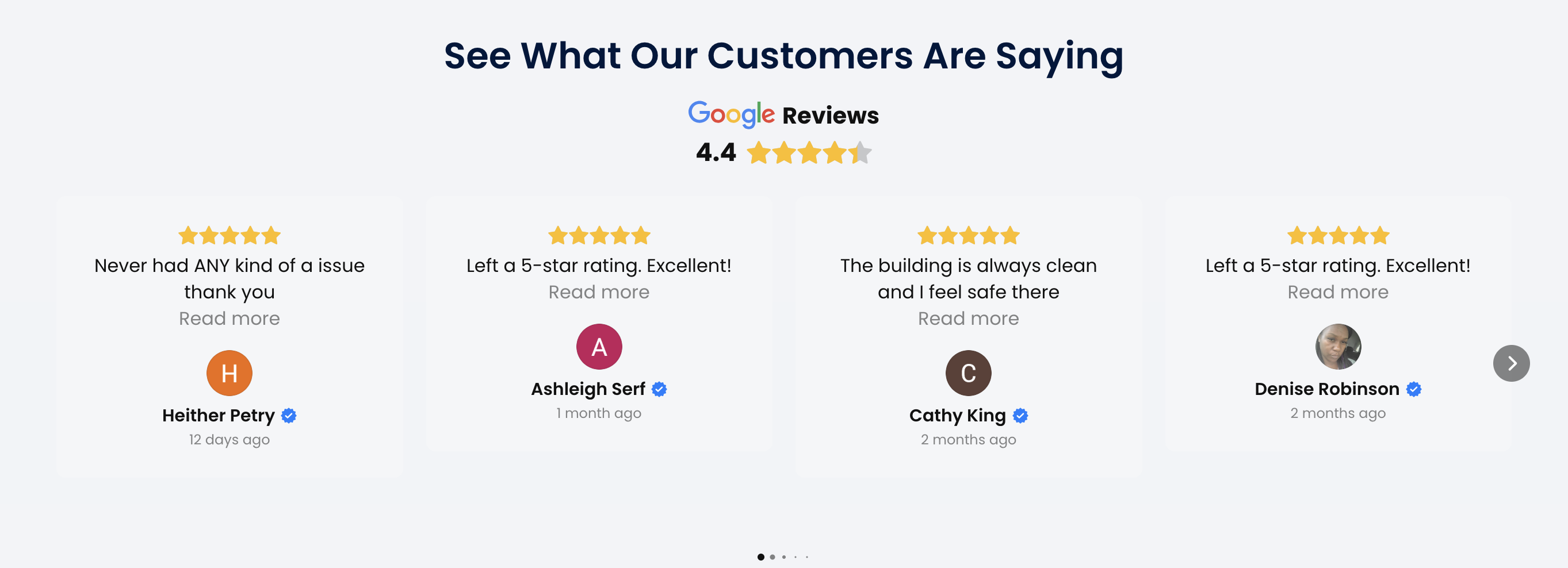
Tenants often decide where to rent before they ever visit the facility, making social proof essential and one of the most impactful self-storage marketing strategies available today. Encourage satisfied customers to leave positive reviews on both Google and Yelp.
Online reviews also influence how facilities appear in local search results, making them an important factor in both visibility and credibility.
It is equally important to respond to reviews, both positive and negative, to show that you value customer feedback. Highlighting these testimonials on your website builds trust and can be the deciding factor for a hesitant renter.
Organic rankings take time to build, so investing in Google Ads is the fastest way to reach people actively looking for space. No matter how great your SEO is, Google displays ads first. By bidding on high-intent keywords like "storage in [City]," you ensure visibility above competitors.
Additionally, list your facility on SpareFoot. Think of it as the "Expedia" of storage; it often dominates search results and can capture traffic you might otherwise miss.

Price is a major factor for renters when comparing nearby facilities. Promotions are excellent incentives to win that comparison. Offering deals like first-month-free or discounted rates for long-term rentals are tried and true promotions that can bring in new tenants.
Limited-time promotions can create a sense of urgency that drives immediate action, but ensure they are used strategically to build occupancy without devaluing your units long-term.
While digital drives discovery, offline methods remain effective for targeting specific local communities and demographics.
One of the biggest mistakes in self-storage marketing is treating it as a fixed expense rather than a managed investment. Without tracking performance, you are flying blind, potentially pouring money into channels that may or may not be delivering rentals.
Effective measurement is about answering one simple question: Is my marketing spend actually filling units?
There are some core metrics you can monitor. Don't get bogged down in "vanity metrics" like social media likes or impressions. Focus strictly on the numbers that impact your bottom line:
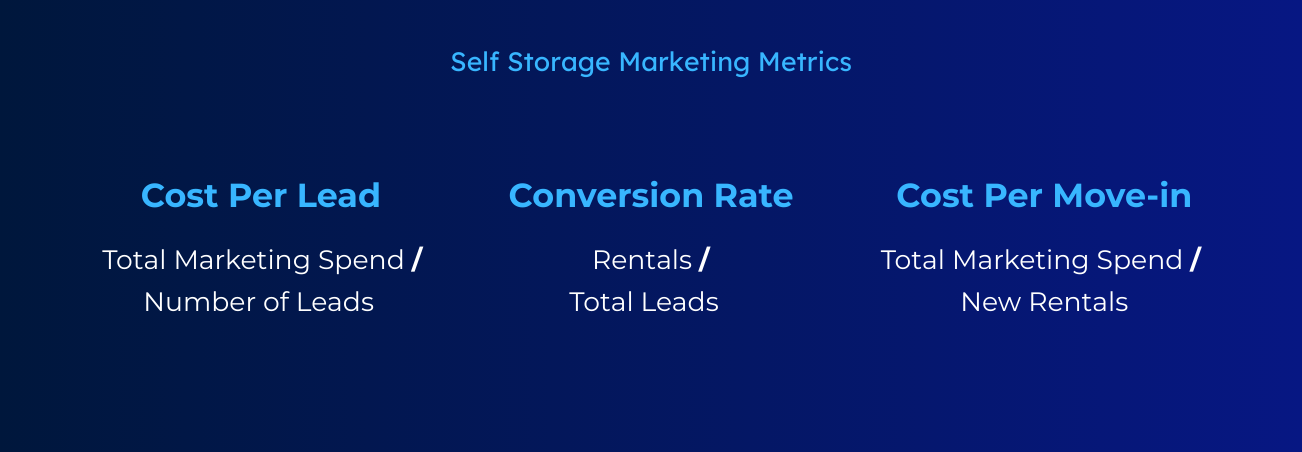
Once you are tracking these numbers, focus on long-term trends rather than daily snapshots. Daily fluctuations are normal, but if you see your cost per move-in creeping up month-over-month, it’s time to refine your strategy.
Crucially, data helps you distinguish between marketing problems and operational problems. If you have low website traffic, you need more marketing (awareness).
But if you have high traffic and low conversions, you likely have an operational issue—your pricing might be too high, or your managers might be missing calls.
The self-storage industry is evolving. Strategies that were considered cutting-edge five years ago, like having a decent website, are now the baseline. To stay competitive, facility owners need to anticipate where renter behavior is shifting and adapt their marketing strategies accordingly.
The modern tenant increasingly expects the "Amazon experience." Faster booking flows, contactless rentals, and fully digital leasing processes are becoming standard. Marketing messages will shift from focusing solely on the physical unit to highlighting how easy it is to rent it. If a customer can book a unit with a competitor in three clicks but has to call you to get a price, you will lose the lease.
Thanks to AI-driven summaries and featured snippets, more users are finding the answers they need without ever clicking through to a website. If a potential tenant asks, "How much is a 10x10 storage unit in [City]?" Google often provides the answer directly on the results page.
This means your Google Business Profile, local listings, and structured data are no longer just traffic drivers; they are the destination.
To win in a zero-click world, your pricing, hours, and availability must be instantly visible and accurate right on the search page, or you could risk being skipped entirely.
Static images are being replaced by dynamic content. Virtual tours are becoming a baseline expectation for customers who want to see the facility without driving there. Additionally, short-form video content that answers common renter questions or shows off security features is becoming a major driver of discovery on social platforms.
The most successful facilities are shifting from reactive to proactive marketing. Instead of waiting for occupancy to drop before increasing ad spend, operators are using data to predict seasonal move-outs. This allows them to adjust pricing and marketing budgets in real-time, ensuring they capture demand before a unit even sits empty.
Effective marketing isn’t a standalone effort; it works best when tightly aligned with operations, pricing, and the customer experience. But for many owners, juggling SEO, ad budgets, and reputation management becomes a full-time job.
Partnering with White Label Storage transforms these fragmented tasks into a cohesive strategy. We provide proven self-storage marketing solutions designed to boost visibility and occupancy without wasted spend.
We focus on data-driven optimization with clear reporting, ensuring you understand your customer acquisition cost. By taking a holistic approach—managing everything from Pay-Per-Click campaigns to brand reputation—we convert traffic into tenants and allow you to focus on growing your portfolio, not managing vendors.