Pricing is perhaps the biggest revenue management lever owners can pull to improve NOI, and there’s a growing divide in how operators approach this process.
One side are operators who rely on instinctive pricing. Their process typically includes looking at their occupancy, comparing rates against a few local competitors, using their intuition, and adjusting rates accordingly.
On the other side of the coin are operators who utilize dynamic pricing, which utilizes automation and real-time data to automatically adjust rates based on market conditions.
As self storage becomes more reliant on technology, using manual processes for pricing (or other mission critical processes) will increase costs, slow growth, and leave money on the table.
In this article, we’ll break down the difference between the two approaches to pricing and discuss why implementing dynamic pricing at your facility could lead to more revenue.

In self storage, dynamic pricing is a revenue management process that automatically adjusts unit rates based on data inputs like physical occupancy, competitor pricing, seasonality, and demand.
The software is driven by rules engines (and now AI) that recommend adjustments to prices when certain conditions occur.
Airlines, hotels, ridesharing apps, and top storage management companies all utilize dynamic pricing because it allows them to rapidly change their pricing based on market conditions and optimize revenue generation.
As the name suggests, manual pricing is a method for adjusting rents that requires operators to gather data, analyze the numbers, and make adjustments based on their findings. While this process may have worked before the advent of dynamic pricing technology, it has several drawbacks in today’s market.
Rates change fast at the local market level. Owners who use manual pricing often wait until their facility is too full or too empty before making a move. By then, revenue opportunities have already been missed.
Demand varies by unit type, size, and time of the year. Manual pricing typically sees only the big picture because there’s only so many data points operators can analyze in a spreadsheet. This type of rate adjustment can also miss more subtle patterns in the data.
Manual pricing can deliver some value on a small scale (think a single facility in a market without tons of competition.) But once an owner adds a second, third, or fourth facility, spreadsheets alone simply can’t drive consistent pricing decisions across multiple markets.
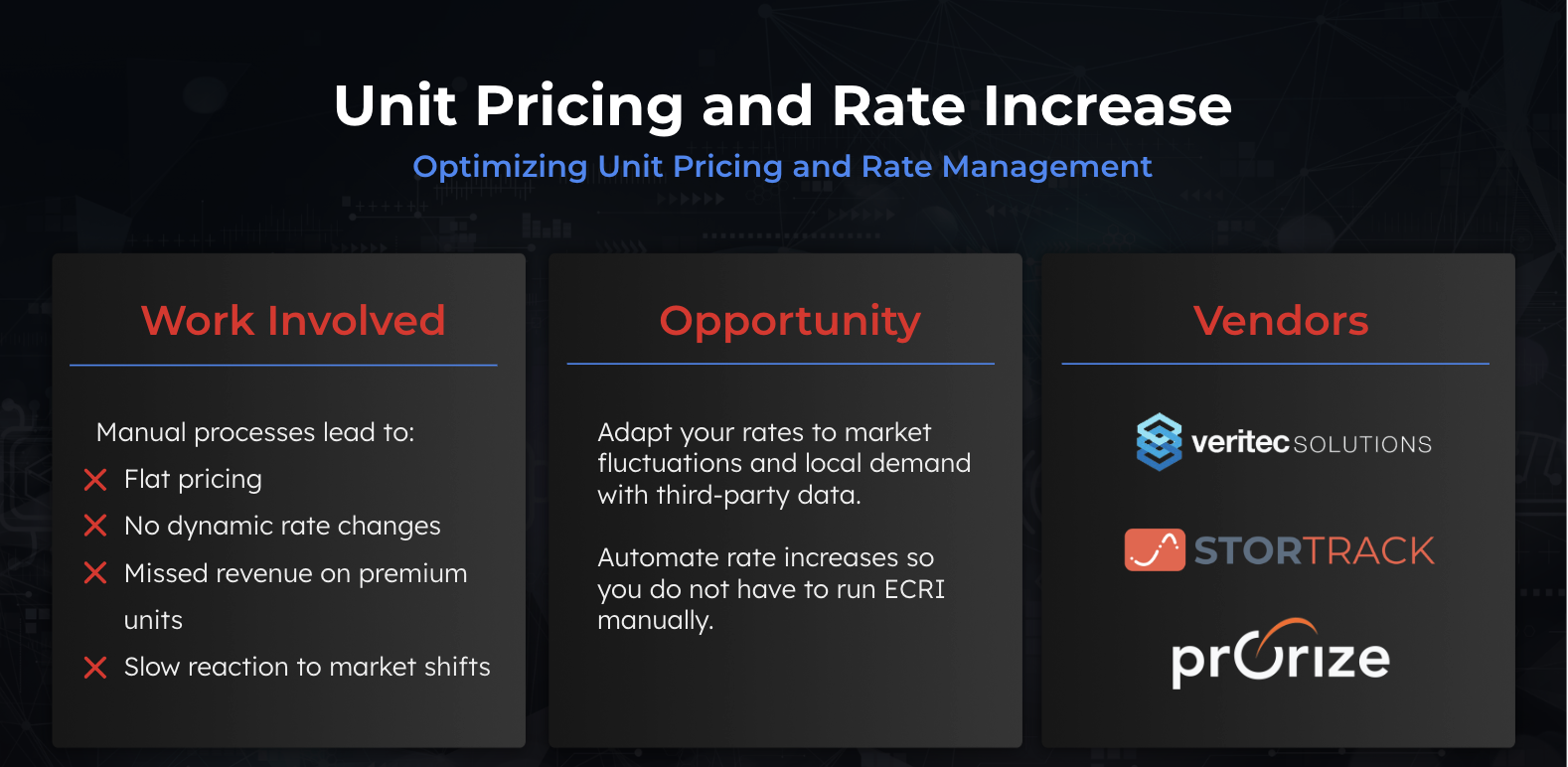
Dynamic pricing in self storage is data-driven, rules-based, and designed to maximize revenue per unit—not just occupancy.
Dynamic pricing uses rules-based software to gather and analyze a range of data points and make changes to unit prices in real-time. Popular examples of this software include Veritec Solutions, StorTrack, and Prorize.
Modern revenue management systems (including our very own RevMan ai) look at:
This list isn’t comprehensive. These systems can analyze dozens of data points, but it’s clear they cover a wide range of information. Once the data is analyzed, the systems perform a number of automated tasks to make recommendations for rate adjustments.
When demand increases, pricing adjusts upward. When demand softens, pricing adjusts downward, but strategically, not arbitrarily. For example, units types that have sat vacant may have their rates lowered, but only after a certain period of time.
Occupancy is only one measure of a facility’s performance, and it’s not precise enough to fully inform your pricing strategy. Dynamic pricing utilizes metrics like revenue per square foot to maximize the pricing potential of every available unit.
10x10s behave differently than 5x5s, especially in urban versus rural markets. Different markets will have different unit mixes that each have varying degrees of demand. If you have unconventional unit types, those probably require their own pricing strategy.
Manual pricing rarely accounts for these nuances because it would take an entire data analytics team to process and analyze that amount of data on a weekly basis.
When the competition makes a move, you want to know about it. Dynamic pricing systems can ingest competitor pricing and automatically adapt to stay competitive without starting a price war.
Existing Customer Rate Increases (ECRIs) are applied based on a blend of market conditions, tenant tenure, and rate-to-market gap. This formula helps ensure you don’t spark a mass exodus when you increase rates. You can find the sweet spot for price hikes that customers will tolerate.
Scott Meyers breaks down how dynamic pricing works in practice:
A $3–$12 increase per unit, applied consistently across a 500-unit facility, adds up to tens of thousands in incremental annual revenue. By using dynamic pricing, you don’t have to make huge capex investments to see an increase in facility income.
ECRI is a tricky strategy. Raise rates too high and tenants will move out en masse. But if you let rates sit for too long, you'll lose out on revenue.
By leveraging the data modeling in dynamic pricing, operators can deploy strategic rate increases that control churn while consistently delivering more revenue per square foot.
Manual pricing is periodic (monthly, quarterly, annually), but demand changes much faster. Modern revenue management software allows operators to adjust rates within hours and capitalize on market fluctuations.
Owners with 5+ properties often see uneven performance because each facility manager prices differently. Manual changes to pricing not only take longer but also deliver unreliable results.
Dynamic pricing creates standardization, repeatability, and predictable revenue outcomes, all of which are essential for scaling.
Revenue becomes more predictable because pricing follows demand cycles instead of intuition. This not only improves NOI but also allows operators to more reliably forecast performance and make investment and operational decisions based for future growth.
Manual pricing is a heavy lift. It requires operators to spend hours gathering data, making calculations, and then tracking the results. And the more manual work involved, the greater the likelihood of human error.
Dynamic pricing takes care of 90% of the work, so operators can manage rates without having to use laborious processes.
Since dynamic pricing takes into account occupancy and revenue at the unit type level, it can make nuanced recommendations about how to adjust pricing on a per unit basis. Consequently, results improve across your entire inventory.
Self storage is in the midst of a sea change. The operators winning today aren’t relying on manual processes to beat the competition — they’re relying on the economics of demand.
The more sophisticated your pricing model, the better equipped you are to compete against REITs, thrive in competitive markets, and maximize asset value.
Ready to see how a modern revenue management system can transform your portfolio? Schedule some time with our team to learn how we can help you maximize NOI.