For a lot of self‑storage owners, the goal is just to make it through tax season and get the paperwork filed. But if you think of taxes as just another compliance hurdle, you might be leaving real money and real cash flow on the table.
Though it doesn’t have to be that way. 2026 is shaping up to be a year where planning ahead makes more of a difference than ever. Instead of simply filing what happened last year, you can actually make strategic decisions now to protect your income and boost the value of your asset.
And you don’t need to be a tax expert to do it.
By understanding how a few key pieces of your business connect to the tax code, you can turn tax season from a stressful scramble into a structured opportunity to optimize your finances.
Your tax bill isn’t only tied to income—it’s shaped by how your facility operates day to day. Because self-storage is such an asset-heavy business, your tax strategy looks different from other real estate sectors. The most important distinction you can make is between money spent to keep the lights on and money invested to improve the asset.
Generally, your spending falls into two key buckets:
These are the day-to-day costs of running your business, and they typically qualify for immediate deductions. This includes:
Don’t overlook your financing costs. Interest on facility acquisition and construction loans is a fully deductible, operating expense.
These are bigger purchases that add value or extend your property's life. Think new roofs, security system overhauls, or building additions. These are usually depreciated over time rather than written off immediately. But accurately tracking these costs is vital for unlocking future deductions.
Here’s where organization becomes your most powerful tax strategy. When you clearly separate a "repair" (like fixing a broken gate motor) from an "improvement" (like installing a new keypad entry system) throughout the year, you make it infinitely easier for your tax professional to maximize your deductions.

This tax season stands out because 2026 opens the door to several tax-saving opportunities for self-storage owners.
On one side, you have the facility itself, where new laws allow you to accelerate write-offs faster than before.
On the other side, you have the income the business generates, which can now be protected more effectively than in previous years.
Here is how to leverage both the building and the business structure to maximize your return:
A cost segregation study breaks your facility into its individual components. Instead of depreciating everything over 39 years, you identify assets that wear out or become obsolete much faster. Think:
The IRS allows you to write these items off over 5, 7, or 15 years. This creates significantly larger deductions early on, freeing up cash you can reinvest right away.
When combined with restored bonus depreciation, you can potentially write off 30–40% of the purchase price in the very first year, dramatically boosting 2026 cash flow.
Now, here’s where planning for 2026 gets particularly impactful. Recent legislation under the 2025 "One Big Beautiful Bill Act" (OBBBA) says that 100% bonus depreciation is permanently reinstated for qualifying property placed in service after January 19, 2025.
For self-storage owners, this means eligible assets placed into service through an acquisition, expansion, or facility upgrade may be fully deducted in the first year. Rather than spreading deductions over time, owners can potentially recover a significant portion of their investment immediately.
This is a massive shift from previous years, where these deductions were phasing out. Now, if you buy a facility or complete a major expansion, you can potentially write off a huge portion of that investment immediately. This dramatically lowers your taxable income for the year, turning a standard tax filing into a major capital recovery event.
"The reinstatement of 100% bonus depreciation presents a significant opportunity for real estate investors... This provision allows taxpayers to immediately deduct the full cost of qualified property—such as certain components of self-storage facilities, like gates/fencing, signage, landscaping—rather than spreading these deductions over a longer lifespan."
"It's important to note, that even though we are now in 2026, it's not too late to implement a cost segregation study for the 2025 tax year. Investors can maximize their tax benefits, improve cash flow, and reinvest those savings back into their properties."
— Ty Meinhardt, Storage Unit Accounting
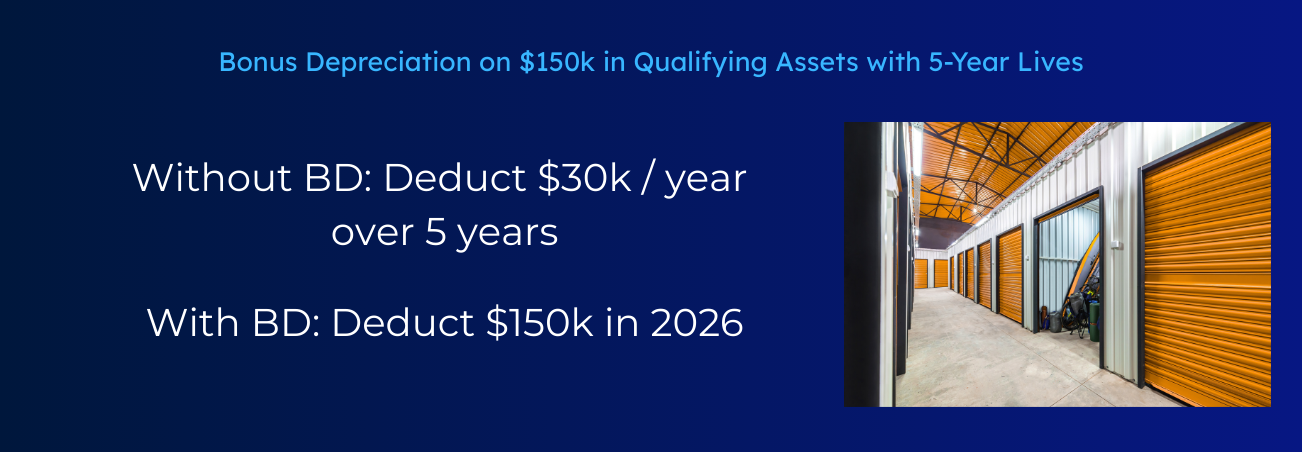
Let’s say you acquire a facility in 2026. A cost segregation study identifies $150,000 worth of qualifying assets with 5-year lives.
That’s an immediate, six-figure reduction in your taxable income for the year, freeing up significant cash to reinvest, pay down debt, or improve your property.
Beyond writing off the physical building, you shouldn't overlook the Qualified Business Income (QBI) deduction. This deduction can reduce the amount of business income that is subject to federal income tax.
If your facility operates as a pass-through entity, such as an LLC or partnership, you may be able to deduct up to 20% of your qualified net business income before calculating your tax liability.
While the QBI deduction is now permanent, what makes 2026 notable is the expansion of the income thresholds.
Higher phase-out limits mean some owners who previously exceeded the cutoff may now qualify. This creates an ongoing tax-saving opportunity that does not require additional spending, but does depend on proper entity structure and eligibility.
Finally, while most tax strategies focus on the facility itself, one notable change can impact self-storage owners at the personal level. The State and Local Tax (SALT) deduction, which covers state income and property taxes paid each year, has been raised from $10,000 to $40,000 for most filers.
For owners who pay significant state income or property taxes, this higher cap may allow up to an additional $30,000 in deductions that were previously limited.
Because self-storage income often flows through to an owner’s personal return, that added household-level flexibility can translate into more capital available to reinvest in the facility, fund improvements, or support expansion plans without pulling cash directly from operations.
Reducing your tax bill does not always require complex accounting maneuvers. Often, the best tax strategy involves simply reinvesting in your own facility. Certain upgrades deliver value twice: they improve operations today and lower your tax liability when you file.
Facilities require ongoing upgrades to stay competitive, and the tax rules often reward those improvements. Provisions like Section 179 and bonus depreciation, which often allow you to expense the full cost of qualifying equipment in the year it's placed in service. Under the current Section 179 limits, you can now expense up to $2.5 million in qualifying equipment.
For self-storage, this commonly includes:
For example, instead of depreciating a $20,000 security upgrade over several years, these rules can let you deduct the entire cost upfront. The result? A more secure, efficient facility and a significant, immediate reduction in your taxable income.
Energy efficiency remains one of the few areas where the government offers dollar-for-dollar tax credits rather than just deductions. However, timing is critical.
Key programs, like the Section 179D deduction for commercial building efficiency (think LED lighting, high-efficiency HVAC, and climate-control upgrades), are set to phase down after June 30, 2026.
This deduction allows owners to claim a per-square-foot write-off for qualifying improvements to a building’s lighting, HVAC systems, or building envelope, including insulation and windows.
Because of this timing, 2026 effectively becomes a “last call” year for many owners looking to take advantage of 179D on new or retrofit climate-controlled facilities.
Similarly, credits for alternative fuel vehicle refueling property (like on-site EV chargers) also face a June 30 cutoff. If you have been considering a solar installation or a major lighting overhaul, 2026 is the year to act. Waiting until 2027 could mean facing stricter requirements or reduced credit percentages.
If you're considering expansion into underserved markets, the rules just became significantly more favorable. For properties located in designated Rural Opportunity Zones, the threshold to qualify for long-term tax benefits has been lowered.
Previously, you had to double a property's value through improvements to qualify for tax-deferred gains. Now, you only need to improve it by roughly 50%.
This lower barrier makes "fixer-upper" rural land far more appealing. In many cases, adding essential self-storage infrastructure—such as paving, perimeter fencing, or access systems—may be enough to meet the improvement test. When structured properly, this can allow owners to defer capital gains and potentially reduce taxes upon exit.
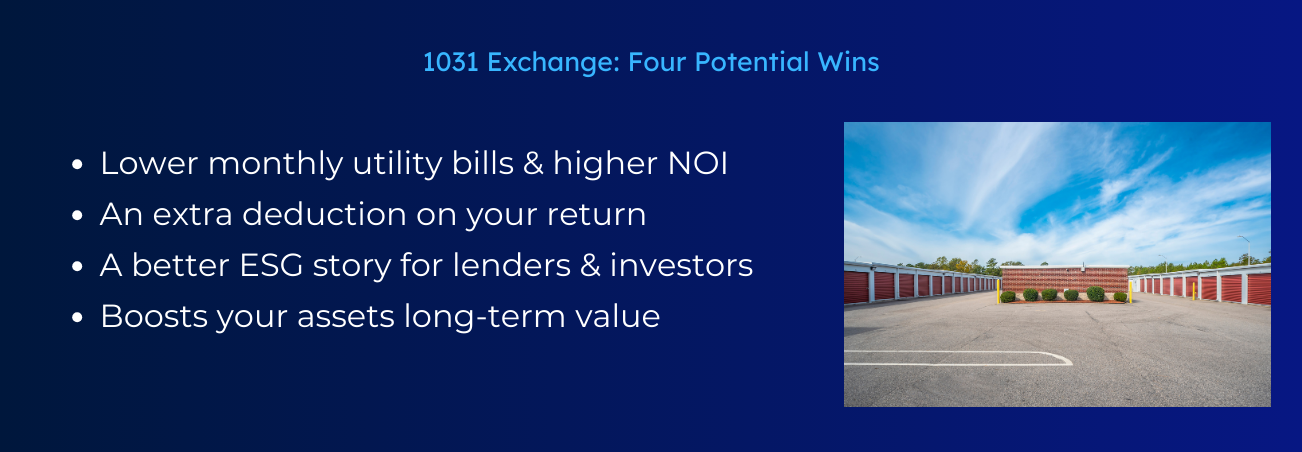
Sometimes the best upgrade isn't a new gate, but a better facility. Despite rumors of tax changes, the "One Big Beautiful Bill Act" left the 1031 Exchange fully intact for real estate investors.
This allows self-storage owners to sell an older or smaller facility and reinvest the proceeds into a larger, higher-performing property without triggering immediate capital gains taxes.
When executed properly, a 1031 Exchange remains the most powerful tool for "upgrading" your entire portfolio, allowing you to swap a high-maintenance property for a stabilized, cash-flowing asset while deferring taxes and preserving capital for reinvestment.
Stop treating tax season as a deadline to survive. Instead, treat it as a natural extension of your business strategy, a time to capture the value you’ve created over the last twelve months.
When you align your facility's daily operations with the opportunities in the tax code, you aren't just filing a return. You are building a more resilient, valuable asset and retaining the capital needed to fuel your next stage of growth.
To learn how hiring a storage management company can help you increase asset value, schedule a call with our team.
Disclaimer: The information provided in this article is for educational and informational purposes only and does not constitute professional financial, tax, or legal advice. Tax laws and regulations, including the "One Big Beautiful Bill Act," are subject to change and interpretation. We strongly recommend consulting with a qualified tax professional or CPA who specializes in the self-storage industry to discuss your specific situation before making any financial decisions.