
Lease-up is the make-or-break moment in the financial lifecycle of a self-storage facility.
That’s because your fixed costs are high from the outset. The longer it takes to fill up units and bring in revenue to serve these costs, the deeper in the red you can go.
To avoid that scenario, you need a self-storage lease-up strategy that gets paying customers in the door and sets your facility up for long-term success.
The main reason owners struggle here rarely comes down to a bad core strategy. The mistake lies in treating lease-up like one massive problem to solve. In reality, you are facing several distinct challenges throughout this phase of your property’s lifecycle. Each one shows up at a different point in your timeline, and every single one demands a specialized response.
In this post, we’ll share how to approach each phase of lease-up so you can build momentum and stabilize your occupancy faster.
Lease-up is the period between when a self-storage facility opens its doors (or changes hands) and when it reaches stabilized occupancy.
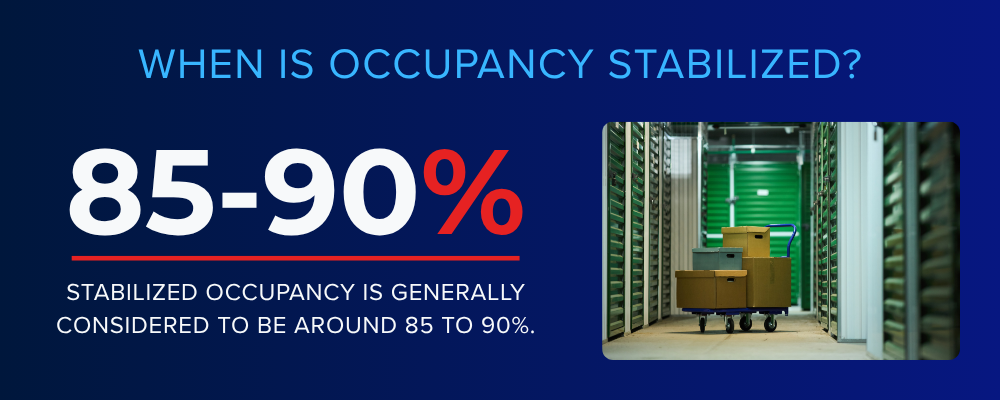
In the industry, stabilized occupancy is generally considered to be around 85 to 90%. That's the point where a facility is performing the way it was underwritten to perform.
It sounds simple enough. But the reason lease-up deserves its own conversation is because of what's happening financially during that window.
Expenses are fixed from day one. The mortgage, the insurance, the staffing, the utilities don’t wait for the units to fill up. Revenue, on the other hand, is still climbing from zero. That gap between outgoing cash and incoming rent is what makes lease-up one of the most financially pressured periods any facility will face.
And it doesn't just apply to brand new builds. Acquisitions go through it too, especially if the previous owner let occupancy slip or the facility needs repositioning in the market. Even a facility that has been open for years can find itself in a lease-up scenario if something knocked it off course.
This is the million dollar question, but the answer is “it depends.” Multiple factors influence lease-up, but the main reasons are:
The more saturated your market, the more difficult it will be to win new customers for your facility. That doesn't mean it’s impossible, only that it will take longer.
The other major force that determines your lease-up timeline. If there’s ample demand in your market, you can more rapidly fill units, raise your physical occupancy, and grow your revenue.
Obviously, the larger the facility, the more units there are to fill. There’s evidence that new builds are getting bigger (in terms of rentable square footage) especially in urban markets where land is expensive — or non-existent.
Three years is the most commonly referenced number, but at White Label Storage we’ve also seen smaller facilities lease up in 12 months or less. It all depends on the context of your market — and how effective your self-storage lease-up strategy is.
Here's something a lot of people entering self-storage don't hear until they're already in it: the market has changed significantly in recent years, and the strategies that worked during boom times are not the ones that work today.
Total U.S. storage inventory grew by roughly 8 to 9% over just a few years, a building wave that overshot demand in several cities and led to localized oversupply and price competition. When demand was surging, facilities were filling up fast and some owners stabilized in under 18 months. That created a set of expectations the current market simply can't support.
Also, oversupply has placed real pressure on rental rates and occupancy, adding stress to new facilities already navigating lease-up challenges. Markets with heavy supply like Atlanta, Orlando, and Phoenix reported some of the worst revenue performances.
And it's not just those markets feeling it. In November 2025, 29 out of the top 30 metros posted rate declines.
So what actually moves the needle during lease-up? Some factors are outside of an owner's control, and some aren't.

Not all lease-up problems look the same. Each stage of lease-up comes with its own set of problems to solve. A facility at 20% occupancy is dealing with a completely different set of challenges than one stuck at 70%, and treating them the same way is one of the fastest ways to stall out. Here's what each phase actually looks like and what to do when you're in it.
At this stage your core problem is visibility and trust. The facility is new, nobody knows it exists yet, and the people who do find it aren't sure they can trust it. The goal here isn't to fill every unit. It's to get noticed and get those first tenants through the door.
What to avoid: Over-discounting to fill units fast. It feels like the right move but it trains the local market to expect low rates and compresses revenue long after lease-up ends. Early pricing decisions have a longer tail than most people realize.
The facility has some momentum now. Traffic is coming in but month-over-month occupancy gains can be inconsistent. At this stage the problem shifts from visibility to conversion and retention. People are finding the facility but the process of turning inquiries into move-ins isn’t optimized.
What to avoid: Treating a conversion problem like a traffic problem. When occupancy stalls in this phase the instinct is to spend more on ads. But if your conversion rate is low or response times are slow, more traffic just means more missed opportunities.
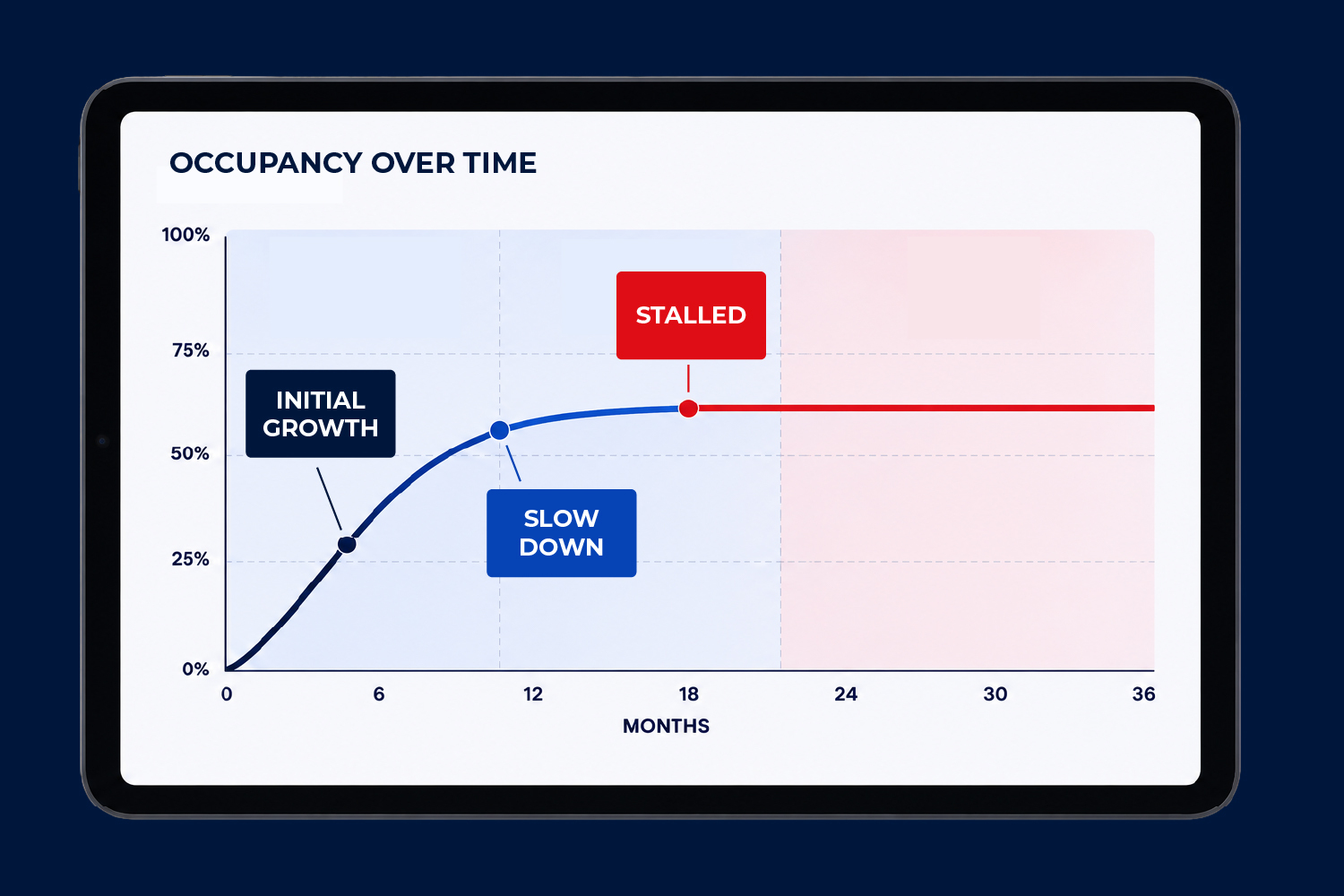
This is the phase that catches the most people off guard. The facility feels like it's doing well. Occupancy is solid. But it's stalled. And month after month it sits in that same range without breaking through.
This is what’s known as the middle plateau, where occupancy hits a wall and net new move-ins don’t outpage move-outs.
At this stage the problem isn't leasing. It's revenue management. The lease-up phase is quietly transitioning into a yield problem, and the playbook has to shift accordingly.
What to avoid: Assuming the plateau is normal and waiting it out. It rarely resolves on its own. A facility stuck at 70% for six months usually needs a deliberate strategy change, not more time.
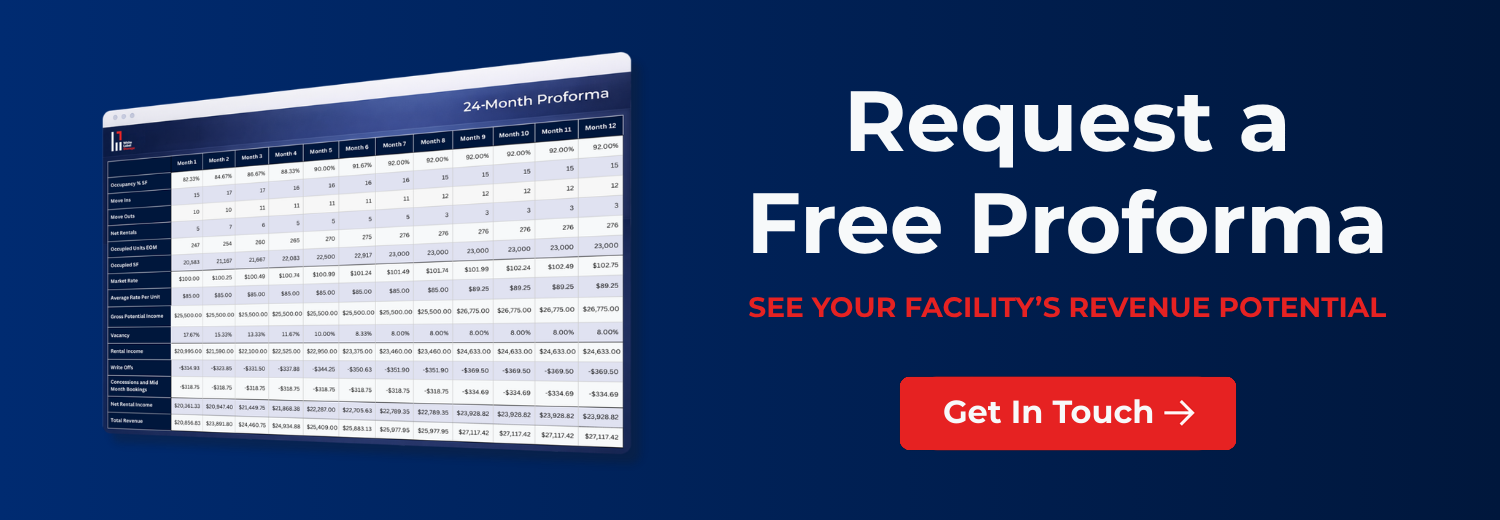
Lease-up is manageable. But it's a lot harder to navigate alone, especially without a clear picture of what "normal" actually looks like at each stage. That's where having the storage management company changes things.
Most owners going through lease-up for the first time don't have a benchmark. You don't know if the 90-day occupancy number is on track or a red flag. You don't know if the conversion rate is competitive or if the pricing strategy is quietly working against you. Without cross-portfolio data and real operational experience across different markets and facility types, those blind spots are hard to close.
We work with owners at every stage of the lease-up journey, from pre-opening strategy all the way through stabilization. Our processes are informed by what’s working across markets and our portfolio of managed facilities. Schedule a demo today.