
If you ask most self-storage operators how their marketing is performing, the honest answer is usually some version of: "We have a Google Business Profile, we're on Sparefoot, and we ran some Google Ads for a while." For a lot of facilities, that's where the conversation ends.
But for Brock Hegr, that's often where the real conversation begins.
As Director of Marketing at White Label Storage, Brock oversees marketing across a portfolio of self-storage facilities at every stage of the growth curve: brand-new builds in lease-up, properties pushing toward capacity, and stabilized assets looking to increase revenue.
We sat down with Brock to talk through the blind spots he encounters most: the things operators are either overlooking entirely or doing halfway without realizing it. Some of them are tactical. Some of them are mindset shifts. All of them are more common than you'd think.
“A lot of owners overlook their Google Business Profile and just see it as a landing page or a landing point for somebody to get more information, whether that would be their phone number, their hours, or their email. But really it's a lot more than that.
We know you have to build trust with your business, and really the number one way to do that online is through the Google Business Profile. Google has an algorithm that says if you've got a certain number of five-star reviews, if you've got more five-star reviews than your competition, then we're going to continue to raise your authority on the page. That also ties back into your website. Your GBP is connected to your website, so that activity can contribute to higher search rankings when somebody is looking for storage online.

And then on Google Maps, when you search for storage units near you, there's a reason one facility shows up before another. A lot of that comes down to trust factors, and trust factors come from reviews. But it also comes from how you respond to those reviews. Positive or negative, reviews should never go dormant. The positive ones should be acknowledged and thanked, and the negative ones should be addressed and taken seriously.
Beyond reviews, there's a strategy to inject high search volume keywords directly into your Google Business Profile, and most operators have no idea this is even possible.
We typically build a keyword list when we set up Google Ads campaigns, words that people in that specific area are actively searching for. You can actually work those keywords into your review responses.
So if someone is searching for climate-controlled storage, and you've used that phrase in a response to a review, you're more likely to surface in that search. Same thing with RV storage, boat storage, any of those high-volume terms that are specific to your market.
Another place you can do this is the FAQ section. Owners can go in there and field their own questions, and in doing so they can push those same high search volume keywords in. Things like 24-hour surveillance, for example. People searching for a facility often care about security, so if that phrase lives in your FAQ, you're going to pull up for people who are searching for it.
On top of that, there are just good healthy habits that a lot of operators skip.
You should be uploading a new photo every week. Google loves to see pages being actively updated and will give precedence to profiles that are.
There's also a posting feature built into GBP that functions almost like a social media tool. If you're consistently making posts and showing that you're actively engaging with your profile, Google rewards that too.
And there's a services section where you can enter up to nine different service types. Most people just put self-storage and leave it at that, but you can add RV storage, boat storage, and other categories that each act as additional signals pulling people to your profile.”
“Honestly, it's the reviews. Not just getting them, but the strategy behind them. Most operators think a review is just a review. But when you understand that the words inside a review and inside your response to that review can actually influence what searches you show up for, it changes how you think about the whole thing.
A customer leaving a review that mentions climate-controlled storage is doing SEO work for you without even knowing it. And when you respond and use that same language intentionally, you're compounding it. That's something the big players understand and most independent operators don't even know is happening.”
“Most storage websites can be a bit embarrassing, honestly. And I say that with respect because I understand that operators are focused on running their facility. But as an industry, self-storage generates massive amounts of revenue, and the investment that goes into these facilities is significant. When the website doesn't reflect that, it's a disconnect that costs you.
Things like slow load times, outdated photos, no online rental capabilities, websites that don't work on mobile. If your website were a physical facility, a lot of operators would be mortified by what they'd see. The website is your first impression and often your only chance to convert a visitor who is ready to rent right now. Storage is a needs-driven decision. Someone isn't browsing your site for fun. They need a unit, they need it soon, and if your site is slow or confusing or doesn't let them complete a rental online, they're gone. They're going to the next result.
The checkout experience matters just as much as the site itself. At White Label Storage we make the rental process as frictionless as possible because we do everything remotely and digitally. A potential renter shouldn't have to come into the facility multiple times, sign paperwork in person, then go back for their keys and their locks. If your website can't get someone from landing to rented without friction, you're losing people who were already ready to convert.”
“At a minimum you need something that is clean, fast, and has easy calls to action. Easy pricing that's visible without having to dig for it. An online checkout process that actually works and works on mobile. And photos that represent what the facility actually looks like today, not five years ago.
Beyond that it comes down to content. Are you giving people the information they need to make a decision? Unit sizes, features, what's included, what the security looks like, what the access hours are. A lot of operators underestimate how much a potential renter is researching before they ever click anything. They're comparing you to the facility down the street and the one on the next block. If your site makes that comparison harder for them, or if it raises doubts instead of building confidence, you've already lost.
The other thing I'd add is that this is becoming even more important with AI search. People aren't just going to Google Maps anymore to find storage. They're asking AI things like what are the five closest climate-controlled storage units within ten miles of me. The way you structure your website content and the information you put on it directly influences whether you show up in those results. So a bad website isn't just a conversion problem anymore. It's a visibility problem too."
“Look, aggregators like Sparefoot do drive real volume. There's a place and a time for them and I don't want anyone walking away thinking we're dismissing them because we're not.
Think of it kind of like Expedia for rentals. Someone can go on there, search for storage in their area, compare options, and complete a rental right through the platform. That visibility is real and it matters, especially for facilities that are still building their own online presence.
The issue isn't using them. The issue is when operators start treating Sparefoot as their marketing plan rather than one channel within a larger strategy. Because when that happens, every dollar you're spending is going toward building someone else's asset, not yours.
I think of it as a toll fee. You're paying to be found on someone else's platform, and when you stop paying that toll, those customers don't follow you anywhere. They were never really tied to you to begin with.
Every dollar you invest in your own website, your own SEO, your own Google presence, is a dollar going into something you own. Something that compounds and gets stronger over time. Aggregators don't do that for you. They rent you visibility. Your own digital presence builds it.”

“It should be a layer, not a foundation. Once you've built something solid that belongs to you, using Sparefoot as an additional distribution channel on top of that makes a lot of sense.
It can help fill gaps, especially during a lease-up phase when you need volume fast and your own presence is still getting established. But leading with it and building your whole acquisition strategy around it is working backwards. Your website is your storefront. Aggregators are just one of several roads that can lead people to it.”
“Storage is a needs-driven decision. Someone isn't browsing casually. They need a unit and they need it now. They're not thinking about it last week and they're not thinking about it next week.
So when someone types "storage units near me" into Google, that is a high-intent customer. They're not researching. They're ready to act. Google Ads lets you be right there in front of that person at exactly the moment they're looking, and that's why it fits so well for storage specifically.
The way it works is that we do our part by building the campaign, doing the keyword research, writing the ad copy, setting up the targeting. But what Google does on its end is find the right person to show that ad to.
It knows a lot about people. It tracks behavior, location, patterns. And there's a learning phase, usually about 30 to 60 days, where Google is essentially figuring out who your best customer is. Who clicks, who converts, who actually ends up renting. Over time the campaign gets smarter and more efficient because of that data.”
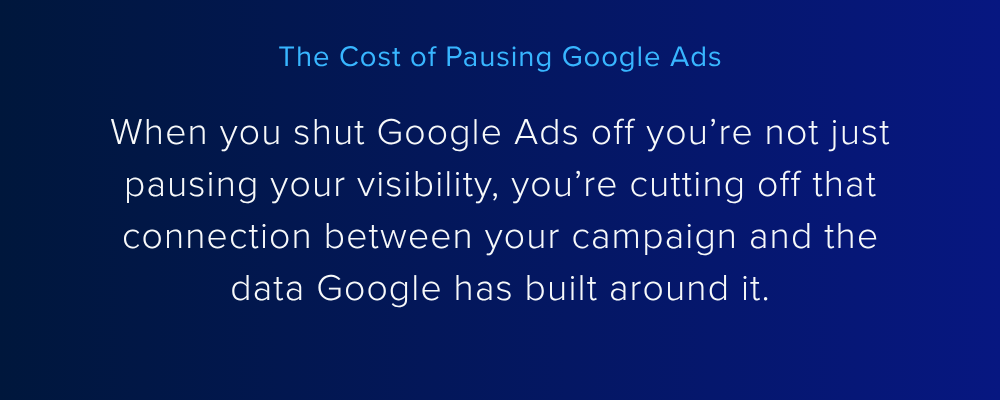
“That's where a lot of operators make a costly mistake without realizing it. When you shut Google Ads off you're not just pausing your visibility. You're cutting off that connection between your campaign and the data Google has built around it.
All of that learning, all of that optimization around who your best customer is, goes dormant. And when you start the campaign back up three months later you're not picking up where you left off. You're starting the learning phase over again. Another 30 to 60 days before the campaign is performing at the level it was before you paused it."
"We see this happen a lot when a facility hits higher occupancy, say 85 or 90 percent, and the operator decides to shut ads off completely because they don't need the volume right now. I understand the thinking but it's the wrong move.
What we recommend instead is what I'd call a maintenance budget. You pull your spend down to something small, but you keep the campaign running. You stay visible in your market, you keep showing up for those potential customers, and most importantly you preserve the intelligence the campaign has built. So when you do need to ramp back up, you're not rebuilding from scratch.”
“A big one is the “set it and forget it” problem. There's a bad reputation that follows a lot of Google Ads management in this industry, and honestly some of it is earned. There are providers out there who set up a campaign, hand it over, and then go completely hands off.
The ads run, money gets spent, and nobody is in there making adjustments, refreshing ad copy, adding negative keywords, optimizing based on what's actually converting. That's how you burn through budget without results.
The way we approach it at White Label Storage is that we're always in the campaigns. We're making adjustments, we're watching what's working and what isn't, we're updating copy, we're refining keywords.
Google Ads is not a channel you set up once and walk away from. The operators who have had bad experiences often had them because someone walked away. That doesn't mean the channel doesn't work. It means it wasn't being managed the way it needs to be."
“The best marketing advantage is the business and its operator itself. At White Label Storage we think about this constantly because in many ways we are the operator. And I think a lot of operators lose sight of that when they're focused on campaigns and budgets and platforms.
Think about what actually generates those positive organic reviews that everyone wants more of.
Those are the things that make someone go out of their way to leave a five-star review. Those are the things that create word of mouth. And the thing about all of that is there's no budget associated with it. You're not spending a dollar on any of it.
There's a gap in this industry between operators who run genuinely great facilities and operators who think marketing is something you outsource and forget about.
And what I've seen consistently is that the operators who run great facilities, who are responsive and clean and helpful, are the ones whose marketing actually compounds. Because the reviews come in, the word of mouth builds, the organic presence grows, and every dollar they do spend on paid marketing goes further because the foundation underneath it is solid."
"Start with the basics. How fast are you responding to leads? If someone fills out a form on your website or sends an inquiry and they don't hear back for 24 hours, you've probably already lost them. Storage is an urgent decision. The person who responds first usually wins.
Then look at your reviews. Not just how many you have but what they're saying. Are people mentioning cleanliness? The staff? The ease of the process? If those things aren't showing up in your reviews it might be worth asking why. And if you're getting negative reviews about any of those things, that's not a marketing problem. That's an operations problem, and no amount of ad spend is going to fix it.
The facilities that do this really well are the ones where the operator understands that everything is marketing. The way the phone gets answered, the way the grounds look, the way a move-in goes. All of it feeds back into your reputation, and your reputation is ultimately what your marketing is built on top of."

Running a self-storage facility means wearing a lot of hats, and marketing is one that most operators are actively thinking about. But thinking about marketing and truly understanding where it is working and where it is silently costing you are two very different things.
As a self storage management company, White Label Storage works with facilities at every stage of the customer journey. Whether you are a new facility trying to get your first tenants through the door, a growing operation looking to push toward capacity, or an established owner who wants to hand the marketing off to a team that lives and breathes this industry every day, there is a version of this work that fits where you are right now.
From paid advertising and Google Business Profile management to full portfolio oversight, the goal is always the same: building a marketing presence that belongs to you, compounds over time, and actually fills your facility.
Discover what we can do for your facility. Schedule a free marketing review today.