We see a common mistake that owners and developers make when projecting revenue for new self-storage facilities: they don’t adequately address what their act of introducing supply to the market is going to do to that market.
The pattern usually looks something like this: A group finds an opportunity to develop a plot of land, pulls up street rates or even achieved rates from nearby facilities, and uses those numbers to build out their revenue assumptions. The pro forma looks great. The returns pencil out. The lender is happy. Everybody moves forward.
The problem? Those rates and occupancy levels existed before your facility showed up.
One of the defining characteristics of the storage business is its hyper-local nature. Your competitive market set is usually a handful of facilities within a tight radius. Customers rarely drive more than a few miles. That means the supply-demand dynamics of your immediate area are everything.
This is actually one of the great things about the industry—it’s relatively straightforward to define your competitive set and understand the landscape. But it also means that a single development can fundamentally change the economics of an entire local market.
Before you break ground, you need to honestly assess the following:
This is basic supply and demand. If you add supply to a market without a corresponding increase in demand, prices fall. In an industry as localized as self-storage, a single facility can represent a significant supply increase.
If you’re developing in Manhattan, serving a population of 9 million people within a dense urban core, your 80,000-square-foot facility probably can’t meaningfully shift the overall supply-demand picture. But how many markets in the country actually look like that? Very few.
In most markets, e.g., a suburb, a mid-size city, a rural county, you might be looking at 4 or 5 existing facilities serving a defined area. Adding a 6th is a 20% increase in supply. That’s not a rounding error. That’s a structural change.
This is where most development pro formas completely fall apart. Developers project their lease-up as if they’re operating in a vacuum—as if the existing operators are just going to sit there and watch you siphon off their tenants.
They won’t.
Put yourself in the shoes of an incumbent operator. Someone builds a brand-new facility down the road and starts advertising aggressive move-in specials. You begin to see your occupancy slip from 92% to 85%. What do you do?
You lower your rates. You start running your own promotions. You get more aggressive on marketing. You do whatever it takes to protect your revenue base. You do not just sit there and do nothing.
Now you’re in a price war, and it’s one you’re poorly positioned to win. The incumbent likely has a significantly lower cost basis than you. Their facility is paid down or close to it. They have a stable, established revenue base. They can afford to drop rates to levels that would be catastrophic for your debt service.
Even if you eventually prevail and capture market share, you almost certainly had to do it at rates far below what your pro forma assumed.

Before you commit capital to a new development, run your numbers through these scenarios. If you don’t like the answers, you should seriously reconsider the deal.
1. If my development causes market rates to fall 20%, does this deal still work?
2. If I turn a market with 5 facilities at 90% occupancy into one with 6 facilities at 75% occupancy, do I still like this deal?
3. Do I have the type of patient capital required to weather a longer lease-up at lower rates than projected?
4. What does my debt service coverage look like at 60% occupancy and 15% below today’s street rates for the first 18 months?
That first question is not hypothetical. A 20% rate decline in a newly oversupplied market is not unusual. We see it all the time. And it doesn’t just hit your facility; it hits every facility in the market, which intensifies the competitive response.
The second question forces you to think about what equilibrium actually looks like after you’ve entered the market. If the existing 5 facilities had a collective 10% vacancy, you haven’t magically created demand for your units. You’ve just spread the same vacancy across more facilities, and yours starts at zero.
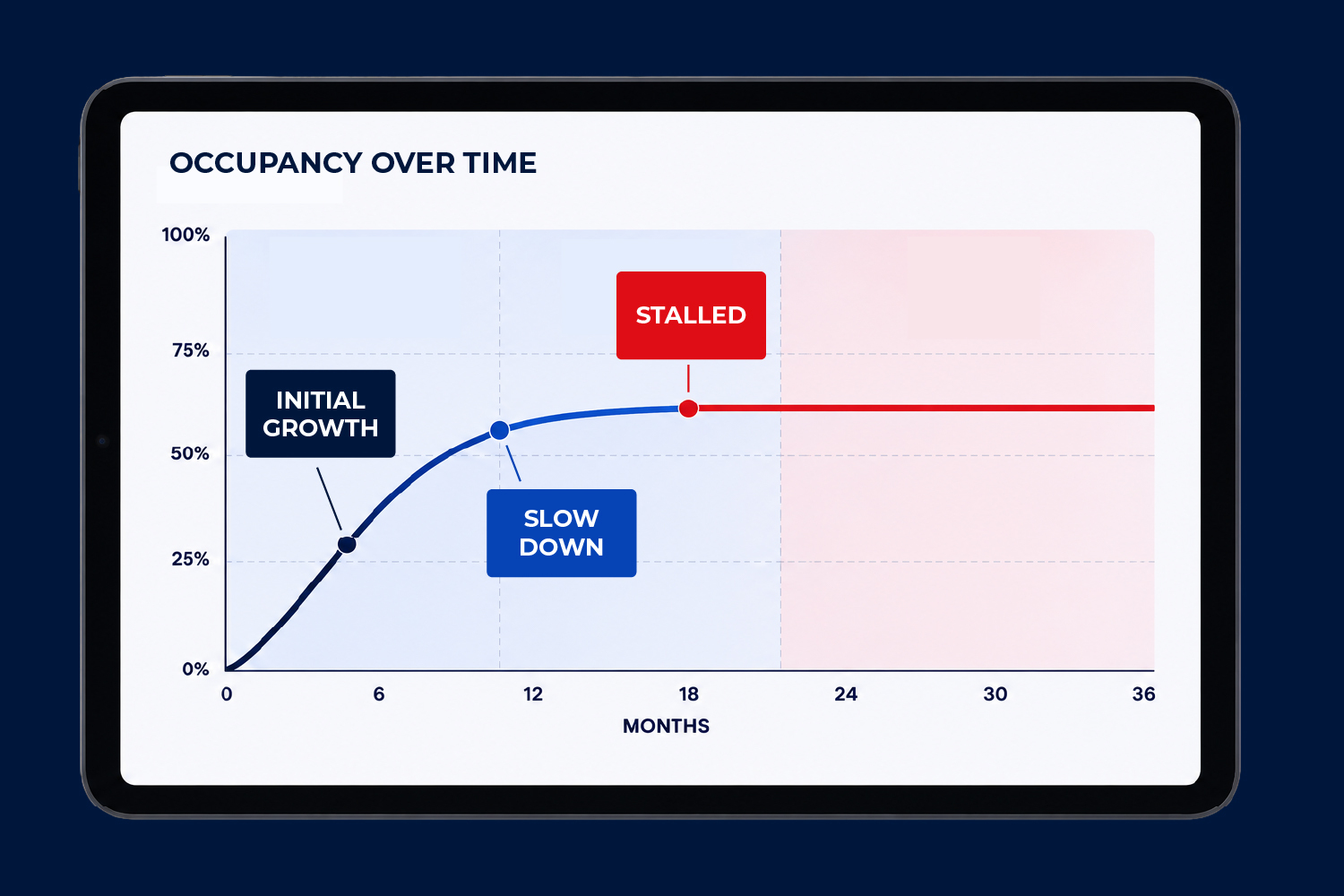
The third question is about your capital structure. If your loan is structured around a 24-month lease-up to stabilized occupancy and it takes 36 or 48 months instead, do you have the reserves and the flexibility to survive? Or does your lender start getting nervous at month 18?
We hear this one a lot. And sometimes it’s true. Maybe you’re bringing institutional-grade management to a market full of mom-and-pop operators who haven’t raised rates in three years, whose websites look like they were built in 2006, and who still answer the phone with a handwritten notepad.
Maybe you’re partnering with a professional storage management company (a white-label operator, perhaps) who brings real revenue management, modern marketing, and a disciplined operating playbook.
Fair enough. But even if all of that is true, you need to be honest about what you’re actually underwriting. If you’re developing into a market that’s at or near saturation, your business plan now rests on two things:
That’s not a feasibility study anymore. That’s a bet on operational dominance. In some cases it can work, but you need to be clear-eyed that this is what you’re underwriting. You are not underwriting a market opportunity. You are underwriting your own ability to be the best operator in the room.
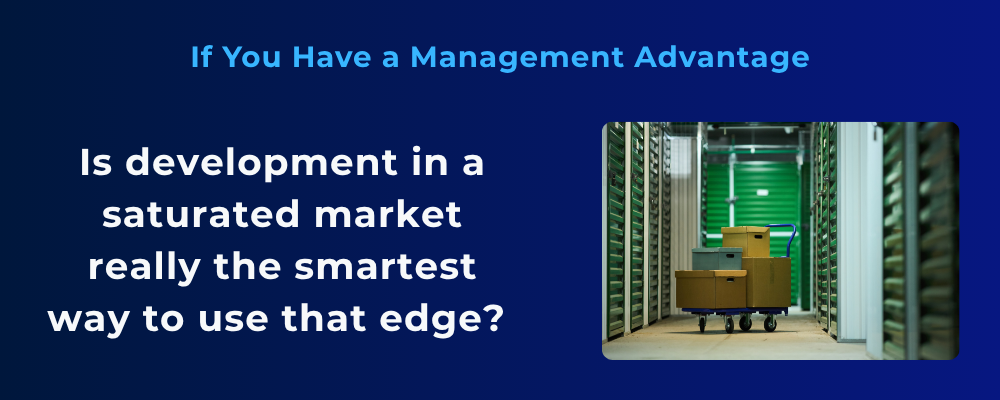
Here’s the question that rarely gets asked: If you genuinely have a management and operational advantage, whether that’s your own team or a best-in-class third-party partner, is ground-up development in a saturated market really the smartest way to deploy that edge?
Consider the alternative. You could acquire an existing facility in a market that’s undersupplied or in equilibrium—a market where the fundamentals already support healthy occupancy and rates. Then you apply your operational advantage to a facility that’s already cash-flowing. You’re not fighting for market share in a market you just oversupplied. You’re squeezing incremental revenue out of a stable base through better rate management, better marketing, better customer experience, and better expense control.
That’s a fundamentally different risk profile. You’re the best operator in a market that was already working, not the best operator in a market you just broke.
Development in a tight market means your operational edge has to overcome the structural headwind of oversupply. Acquiring in a healthy market means your operational edge is additive—it’s upside on top of a deal that already pencils. One of those is a much better bet.
Here’s the other thing about the operational edge argument: it’s not a permanent moat. Competitive response doesn’t just mean lowering rates. It also means leveling up.
We get calls all the time from facility owners who are bringing in professional management precisely because someone like you developed a new facility in their market and started chipping away at their occupancy. They watched their numbers slip, realized they needed to respond, and went out and found a management partner who could modernize their operations, optimize their pricing, and compete effectively.
So the very operational edge you’re counting on to win the market may be the thing that forces your competitors to up their game. Six months after you open, the mom-and-pop down the road might have a new website, dynamic pricing, a call center, and a revenue management platform. Now you’re not competing against the operator they were. You’re competing against the operator they’ve become—and they still have a lower cost basis than you.
Here’s what this looks like in practice. Say you’re looking at a market with 5 existing facilities, each averaging around 500 units. Total market supply is 2,500 units. Occupancy across the market is 92%, meaning about 2,300 units are rented. The average achieved rate is $120/month.
Your pro forma probably assumed you’d hit 50–60% occupancy in Year 1 at $120/month. The reality might be 30% at $105. That’s not a bad quarter; that’s a fundamentally different deal. And your DSCR just went from comfortable to concerning.
None of this means you should never develop self-storage. There are genuinely undersupplied markets where new facilities are needed and will perform well. But finding those markets requires more than pulling street rates off a competitor’s website and plugging them into a spreadsheet.
It requires understanding that:
The developers who succeed are the ones who underwrite to the post-development reality, not the pre-development fantasy. If the deal still works when you stress-test it against competitive response, rate compression, and a longer lease-up, then you probably have a good opportunity. If it only works when everything goes right, it’s not a deal. It’s a hope.