
Ask ten facility owners how they decide on a marketing budget, and you will likely hear ten different answers. Some look at last year’s occupancy. Others pick a number that feels reasonable and hope it delivers results.
The challenge usually is not a lack of capital. The challenge is having a clear framework for how that marketing budget should work within a holistic strategy. Without one, marketing decisions tend to be reactive rather than intentional.
Rather than breaking down spreadsheets and tactics, the focus of this article is on how a marketing budget should be approached strategically.
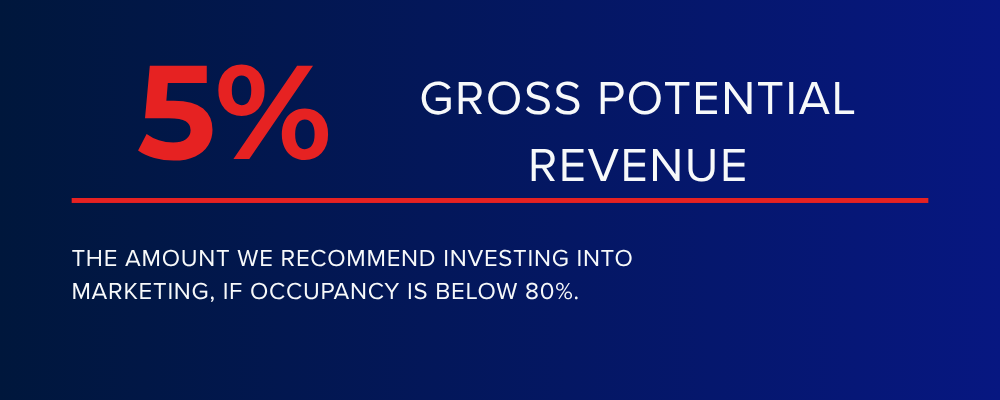
We advise facilities to allocate 5% of gross potential revenue to marketing if you're under 80% occupancy. That percentage creates a strategic floor, one that replaces guesswork with structure and gives marketing a clearer role in long-term growth.
Many operators prefer a flat marketing budget because simplicity feels safe. Putting a dollar figure on a spreadsheet creates a sense of control. You pick a number, approve the expense, and move on to the next operational headache.
The problem is the market never stays still. Demand shifts. New competitors open nearby. Rates change. A fixed budget assumes conditions will remain the same from January through December, even though the business rarely works that way.
Anchoring marketing spend to a percentage of revenue offers a more realistic approach and supports a stronger marketing strategy, one that adjusts as your business changes.
Think of this method like a thermostat rather than a space heater. A space heater puts out the same amount of heat no matter what the room needs, which can waste energy or fall short when temperatures drop. A thermostat responds to its environment and adjusts automatically.
A revenue-based marketing budget works in a similar way. When performance is strong and revenue increases, marketing investment rises alongside it.
That additional spend supports momentum and creates room to push occupancy further. When revenue slows, the budget naturally tightens. This keeps spending in check without requiring rushed decisions or reactionary cuts.
A percentage-based marketing strategy needs a clear starting point. For most self-storage facilities in lease up or below stabilized occupancy, that baseline sits around 5% of gross annual revenue.
Why this percentage? It gives facilities enough room to build visibility, generate consistent lead flow, and support move-in activity during the stage where marketing needs to work the hardest. We often use it when managing facilities that need to lease up, and it has helped properties under our management grow in a variety of markets.
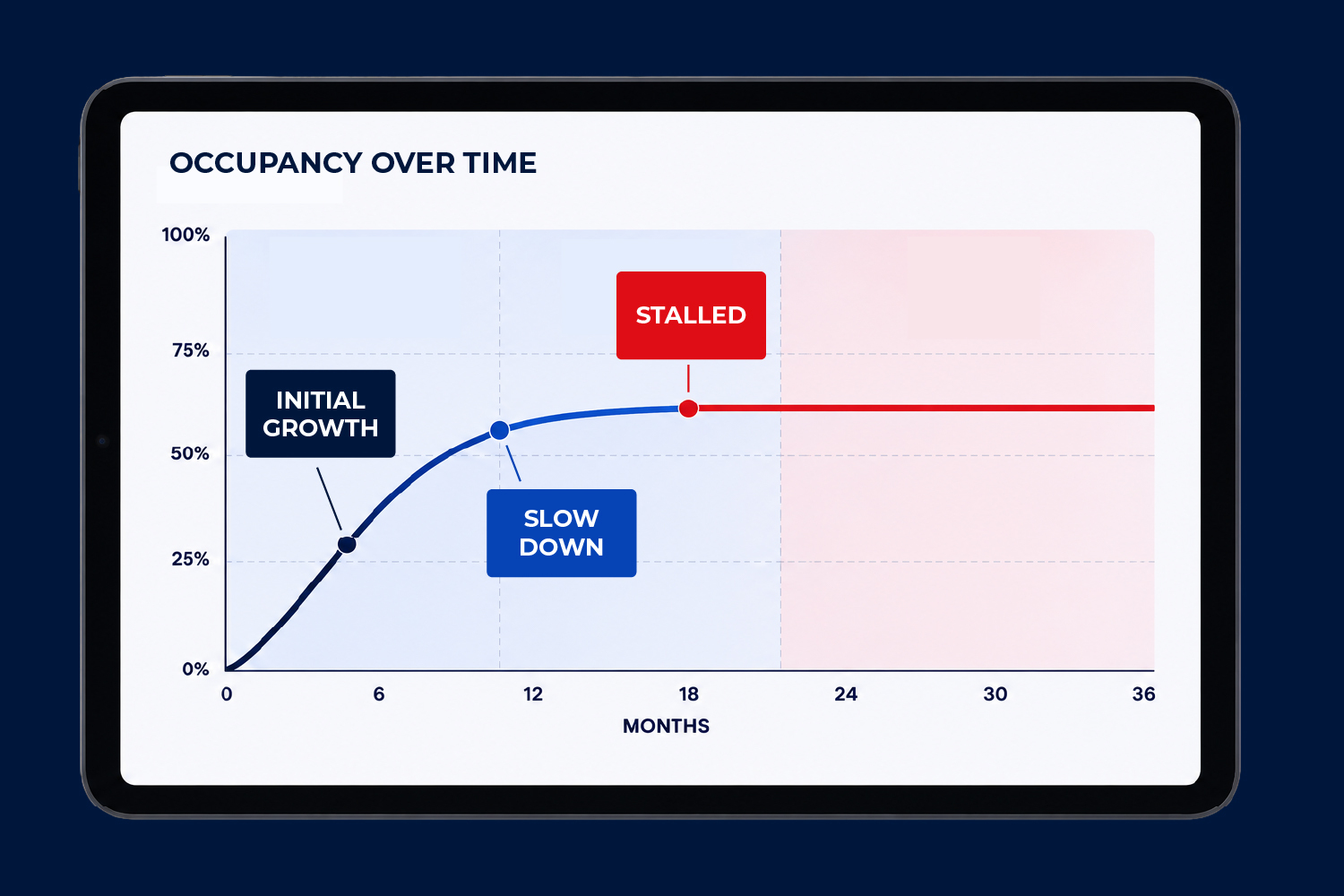
But 5% is not meant to be a blanket number applied forever. Revenue is the starting point, but to make that number useful, you also have to look at where the facility currently stands from an occupancy perspective. A facility with more vacancy to fill will usually need a more aggressive marketing investment than one already operating near stabilization.
That is why we recommend using revenue as the starting point, then adjusting the percentage based on occupancy:
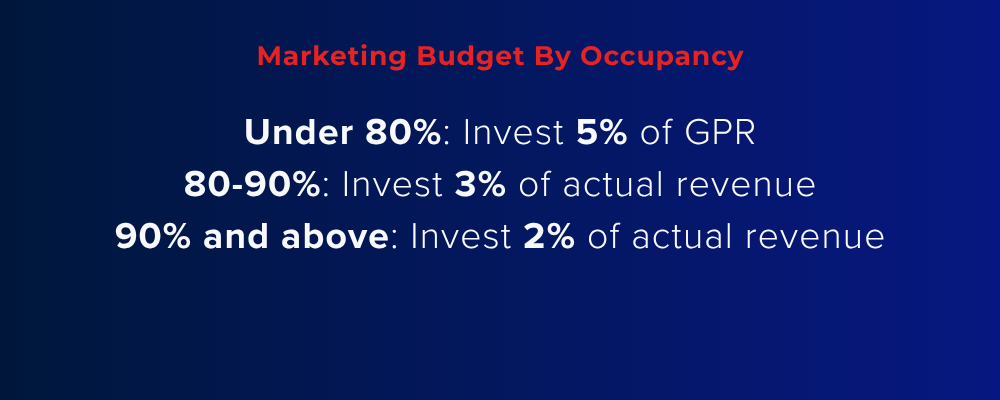
To make this concrete: if a facility is below 80% occupancy and is predicting $500,000 in gross potential revenue revenue, a 5% marketing allocation would create a budget of $25,000 per year — about $2,100 per month. That's enough to maintain a strong local SEO presence, run targeted paid search campaigns, and still have the budget left for seasonal promotions.
If that same facility reaches 80-90% occupancy, the budget may shift closer to 3%, or $15,000 per year of actual revenue. Once the facility is above 90% occupancy, the budget may shift closer to 2%, or $10,000 per year, again with actual revenue.
This approach keeps marketing tied to the financial reality of the property while giving operators a practical way to scale spend up or down.
Every facility is different, but applying this spend across Google Ads, listing sites like Sparefoot, and reputation management has driven success across our portfolio.
For example, data-driven marketing spend was a core part of how we helped a 600+ unit facility grow revenue 20% in one quarter.
This number is not meant to be rigid. Certain scenarios may call for an even larger investment if the competitive landscape or growth opportunities warrant.
So what does this approach actually deliver? When used intentionally, the 2-5% guideline becomes one of the most practical marketing strategies a facility can follow.
Marketing should stay active instead of cycling on and off. Google campaigns typically take 30-60 days to really start performing because the algorithm has to learn who your best customers are based on click and conversion data.
Once you have a baseline, you can start forecasting how many leads to expect from digital marketing every month and begin making more confident decisions about resource allocation.
Facilities that underinvest in marketing often rely on discounts to fill units. A consistent 3-5% investment supports steady demand, which reduces the need for reactionary rate cuts and short-term move-in specials.
One of the biggest challenges in self-storage marketing is knowing what is working. When spend remains consistent, performance trends become easier to spot. This makes it possible to adjust marketing strategies based on real data rather than isolated results.
A reliable marketing budget buys you something money rarely can: breathing room. Once that 2-5% baseline exists, lead flow often stabilizes. Performance becomes reliable rather than random.
That foundation offers more than stability. It creates room to choose your next move.
As your facility matures, the role of your budget evolves. After occupancy stabilizes, we recommend reducing your budget (closer to 1%) without completely turning spend off.
Your marketing is now in maintenance mode, where its primary function is to replace move-outs and keep occupancy stable.
In this part of the lease-up lifecycle, it may be tempting to shut off Google ads. This is an all-to-common mistake. Resist the urge.
Even if your occupancy is in the 90’s, you need to keep your campaigns running. If you turn them off, all the data Google has accrued about your target audience (remember the 30-60 learning phase?) will disappear.
When occupancy slips and you inevitably have to turn Google Ads back on, the algorithm will start from square one, which means a longer wait time and more spend before the channel starts producing quality leads.
The 5% allocation is an easy method for rolling out a marketing budget. But to truly understand what your marketing is doing for your property, you need to analyze the return on investment.
There are numerous approaches to this problem, but the ideal scenario is understanding how much profit your marketing investing is delivering. For that analysis, we recommend a LTV:CAC framework.
We explain how to calculate LTV:CAC here.
This rubric compares your lifetime customer value (LTV) and customer acquisition cost (CAC). The results will give you a ratio that shows how sustainable your acquisition costs are relative to your business profitability.
For example, a 3 to 1 ratio is considered healthy in a fixed asset business like self storage. If your LTV:CAC is below that ratio, you’re not generating enough income from your customers to justify the acquisition cost.
The 5 percent rule offers a useful framework, but no two facilities operate under the same conditions. Market dynamics, occupancy goals, and competition all influence how that budget should be applied.
The real challenge is not deciding how much to spend. It’s making sure the budget works as hard as the business does. Anyone can allocate dollars. Turning that investment into consistent, measurable performance takes planning, discipline, and experience.