
In the years after the Covid pandemic, the self storage industry has had the same theme on repeat: oversupply. Which markets have too much inventory, which metros are seeing rent compression, which Sun Belt cities built too fast. It's an important conversation, and we've covered it ourselves. But it's not the only conversation worth having.
Because while everyone is focused on where there's too much storage, not enough people are asking the opposite question: where is there not enough?
There are markets across the country right now where the supply of storage space falls dramatically short of what the local population actually needs. We're talking cities where the math simply doesn't work in favor of new development, where the barriers to building are so high that the gap between supply and demand just keeps widening.
And for operators and investors paying attention, that gap is where some of the most defensible opportunities in the industry are sitting right now.
At first glance, the answer seems simple: a market is undersupplied when it doesn't have enough self-storage. And that's not wrong, but it's not the whole picture either.
The industry typically measures supply in terms of square footage per person. Nationally, the average is roughly 7 square feet of self-storage space per capita, and that benchmark has held fairly steady for years.
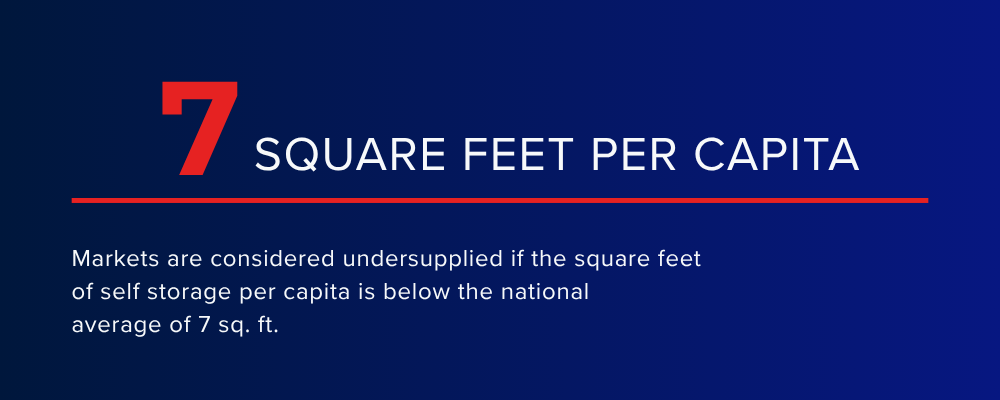
When a market falls well below that number, it's your first signal that available storage may not be keeping up with what the local population needs.
But here's where it gets tricky. Low per-capita supply doesn't automatically mean a market is ripe with opportunity. A city can have very little storage relative to its population and still not have enough demand there to support it.
Slower economic growth, weaker housing activity, or limited population movement can all reduce the need for storage, even when inventory appears scarce.
Providence, Rhode Island is a prime example. Despite having just 1.8 square feet of storage per capita, weaker housing turnover and softer migration trends have contributed to negative rent growth, showing that scarcity by itself doesn't automatically translate into pricing power.
The markets that are truly, functionally undersupplied share three things in common:
1. low per-capita inventory,
2. a limited construction pipeline,
3. and upward pressure on street rates.
When all three show up together, you're looking at a market where the shortage is real and operators are being rewarded for it. When only one or two are present, the picture gets murkier and any decision to invest or adjust strategy deserves a harder look.
If an undersupplied market offers stronger rent growth and limited competition, the obvious question becomes: why hasn't more storage been built?
The natural assumption is that developers will eventually fill the gap. That's how most real estate sectors work. Demand increases, new projects follow, and the market gradually balances itself over time.
However, self-storage doesn't always follow that pattern.
Many of today's most undersupplied markets have remained that way for years, not because developers aren't interested, but because building new facilities is far more difficult than demand alone would suggest. In these markets, the barriers to development are often the very reason the supply gap exists in the first place.
One of the biggest obstacles is simply finding somewhere to build. In many of the country's most undersupplied markets, developable land is either prohibitively expensive or virtually nonexistent.
For example, a developer looking to build in Boston or New York isn't choosing between several attractive sites. They're competing for a handful of parcels alongside multifamily, retail, office, and mixed-use projects that municipalities often view as a higher and better use of limited land.
Even when land is available, getting approval to build is another challenge. Similar to restricting self-storage development, a growing number of municipalities have introduced stricter zoning requirements, development moratoriums, or outright bans on new facilities.
Whether the motivation is preserving tax-generating commercial space, responding to community concerns, or directing growth toward other property types, the outcome is the same: fewer self-storage projects make it from proposal to completion.
Building in these markets is significantly more expensive than building in the Sun Belt or many secondary metros, where most new self-storage development has been concentrated in recent years. Land, materials, labor, permitting timelines, and compliance requirements all carry a higher price tag in the types of cities that tend to be undersupplied.
And even when a project makes it that far, financing can become the next hurdle. Lenders have grown more selective with speculative self-storage development loans, particularly in high-cost markets. As a result, developers who manage to find a viable site and navigate the zoning process may still struggle to secure the capital needed to break ground.
Some markets are simply hemmed in by geography. Hawaii is an island. San Francisco is a peninsula. Older Northeast cities have limited greenfield sites and historic preservation rules that make even adaptive reuse more complex than building from scratch. When the physical footprint of a city can't expand, neither can its storage supply, at least not at the pace demand would justify.
The markets below share one common characteristic: available self-storage hasn't kept pace with long-term demand. While each has its own story, they consistently rank among the country's most supply-constrained markets when you look at per-capita inventory, construction activity, and rent performance.
Last Updated July 2026. The information below is compiled from publicly available sources and updated on a regular basis. Market conditions and supply dynamics can change quickly, and some figures may have shifted since this was last updated. This is intended as a starting point for research, not a substitute for direct market analysis or consultation with a qualified real estate professional.
While every market on this list is undersupplied, they didn't all get there the same way. A closer look at a few standouts helps illustrate how different factors can produce the same result:
If there's one market that defines structural undersupply, it's Boston. At 0.7 square feet per capita with no new supply delivered in 2025 or scheduled for 2026, there is effectively no relief on the horizon. That scarcity has pushed street rates to $223 per month, up 9.7% year over year, making it the fastest-appreciating major market in the country. The city's dense urban environment, limited development opportunities, and high cost of living create the exact combination of barriers we outlined in the previous section, and none of those factors are changing anytime soon.
The Midwest has quietly become one of the strongest-performing regions in self-storage. Occupancy in the Midwest rose 60 basis points year over year in Q4 2025, making it one of only two regions posting meaningful improvement while the South declined. Chicago posted 14.4% annual rent growth in the first half of 2025, a number that would be a headline in any coastal market.
What makes the Midwest particularly interesting is what's driving the demand. These aren't markets riding volatile migration patterns. Storage usage here is tied to household fundamentals: smaller living footprints, life-event turnover, and steady small-business use. That creates a more predictable customer base than what you see in Sun Belt metros where demand swings with population booms and busts.
The West Coast presents a more nuanced picture. San Francisco and San Jose are some of the most supply-constrained markets in the country by the numbers, with San Francisco at roughly 2.7 square feet per capita and San Jose carrying virtually zero new construction. The barriers to entry are sky-high and unlikely to change.
But broader economic softness in parts of the Bay Area has kept rent performance from matching what you'd expect given how tight supply is. San Diego at 4.2 square feet per capita offers a more balanced profile, where decades of strict land use constraints have kept inventory lean and new additions are more likely to relieve pressure than tip the market into oversupply.
Being in an undersupplied market is a strategic advantage, but it's not a guarantee. The supply gap creates the conditions for stronger performance. What you do with those conditions is what actually determines the outcome.
If you're already operating in one of these markets, you have something most of the industry is fighting for right now: room to push rates. Demand is outpacing supply, tenants have fewer alternatives, and the competitive environment that's compressing rates in Sun Belt markets isn't showing up at your door the same way. That's a window, and the operators who capture the most value from it are the ones actively managing revenue, not just collecting rent.
That means running a disciplined ECRI strategy to push existing tenant rates closer to market. It means evaluating your ancillary revenue streams, from tenant protection to retail and late fees, because every dollar of incremental revenue in a supply-constrained market is a dollar your competitors can't easily replicate by undercutting you on price.
And it means investing in your digital presence and conversion experience, because when there are fewer facilities for customers to choose from, the ones that show up first and convert fastest are capturing a disproportionate share of demand.
Undersupplied markets offer some of the most defensible income streams in self-storage right now. The structural barriers that keep supply low are the same ones that protect your investment from the kind of oversupply-driven rent compression happening elsewhere.
That said, the trade-offs are real. Entry costs are higher. Deal flow is thinner. And you're unlikely to find the same volume of acquisition opportunities you'd see in a Sun Belt market where operators are under pressure to sell.
The dominant strategy in these markets right now is acquiring existing facilities at a discount to replacement cost. Ground-up development is difficult for all the reasons we covered earlier, but facilities that are already built, already operating, and simply not being managed to their full potential represent real upside. That's where professional self storage management really shines.
If you really think about it, oversupplied and undersupplied markets are really two sides of the same coin. The industry has spent a lot of time talking about where new development has outpaced demand, but understanding where supply has struggled to keep up can be just as valuable.
Undersupply isn't simply about having fewer facilities. It's about understanding the conditions that have kept new competition at bay and recognizing what those conditions mean for pricing, operations, and long-term investment potential. The markets highlighted here remind us that some of the strongest opportunities aren't always found where the most construction is happening. Sometimes they're found where construction has been difficult all along.
At White Label Storage, we help owners turn that understanding into action through data-driven operations, revenue management, and strategies tailored to the realities of each local market. Because no matter where your facility is located, the strongest results come from making decisions based on the market you're in, not the headlines everyone else is reading.