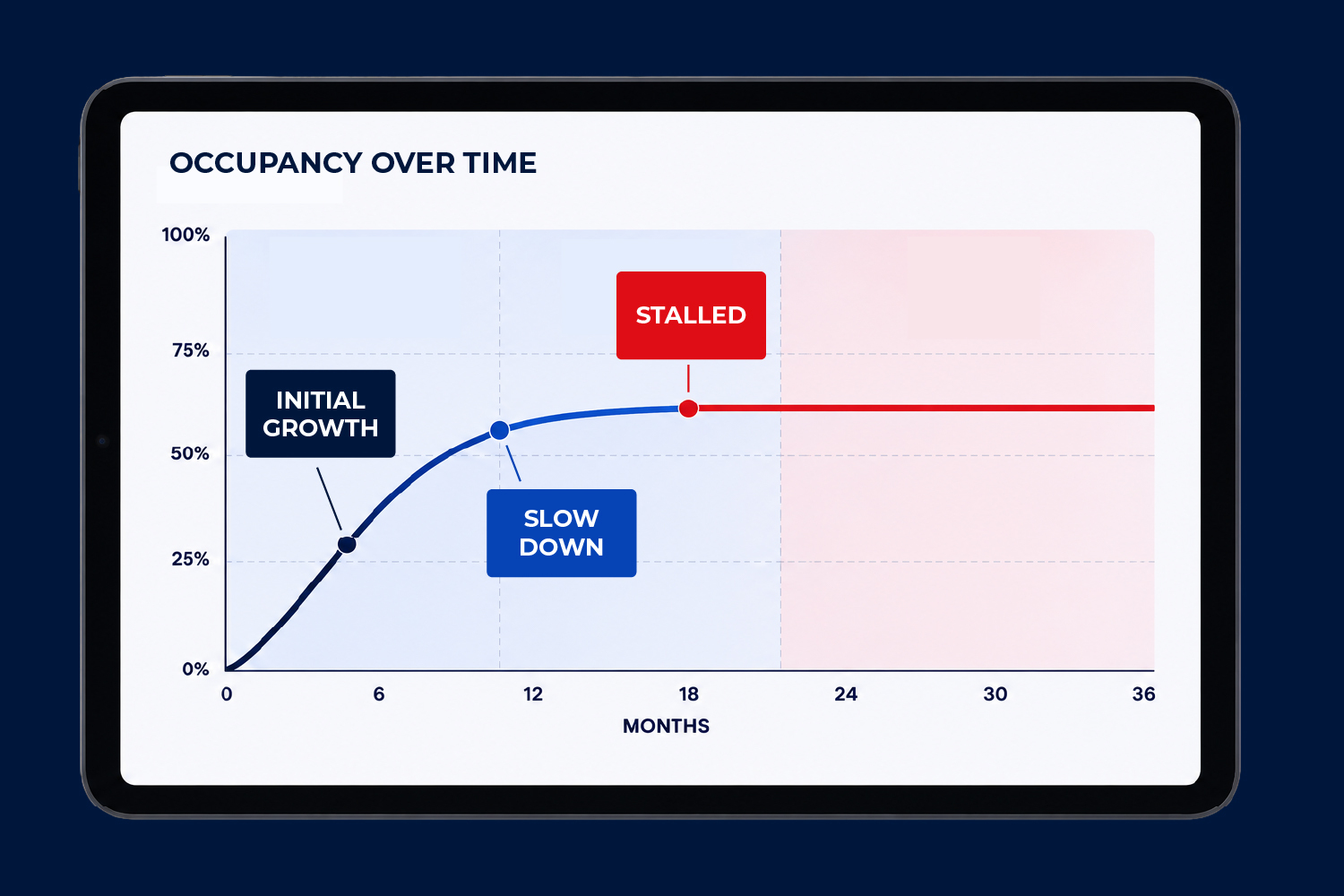
Here's a story we see all the time: A facility opens and the first several months of lease-up look great. Occupancy is growing at 3% a month, and it feels like you're on track for a 2-3 year stabilization.
Then, somewhere around 40–55% occupancy, you notice a plateau. You're still renting roughly the same number of units a month, the Google ads are still running, the team hasn't changed, but occupancy barely moves.
It feels like a marketing problem or lead conversion problem. In most cases, nothing has actually changed in your approach. The real difference is you’re starting to get move-outs.
On day one you have almost no move-outs, because you have almost no tenants. Every rental you sign is nearly pure growth.
But move-outs aren't a fixed number. They scale with how many occupied units you have. The more tenants you're acquiring, the more of them leave each month. And there's a straightforward way to estimate how many.
If your average length of stay is L months, then in a given month roughly 1/L of your occupied units will vacate. A 12-month average stay implies about 8.3% of your tenants leave monthly; an 18-month stay, about 5.6%; a 24-month stay, about 4.2%. So:
Monthly move-outs ≈ Occupied units ÷ Average length of stay (in months)
Run that across occupancy levels for a 250-unit facility and the move out math becomes more clear:
At 40% occupancy with a 12-month average stay, you're bleeding about 8 units a month. At 90% you're bleeding almost 19. Same building, same tenants behaving the same way, but the churn more than doubled simply because the base got bigger.
Say you're consistently signing 12 new rentals a month. That’s a genuinely respectable number for a lot of markets, and it feels like plenty when your facility is empty.
Your net growth in any month is just:
Net growth = Move-ins − Move-outs = 12 − (Occupied ÷ L)
That equation stops growing the moment move-outs catch up to your 12 move-ins. Set them equal and solve, and you get your ceiling: occupied units = 12 × L.
With new 12 rentals a month and a 12-month average stay, you top out at 58%. You simply cannot get past it at that pace. Stretch the average stay to 24 months, and the exact same move-in rate fills the building. Length of stay isn't a footnote here: it moves your ceiling by 40+ points of occupancy.
Monthly move-outs climb slowly so they are really easy to miss when comparing month-over-month data. There is a lot of variance month-to-month as well, which further obscures the problem. Here's the month-by-month path for that 250-unit facility at 12 move-ins/month and a 12-month average stay:
Early on you're netting +9 a month and that might feel like it is working. By month 12 you're only netting +4, but you're at 37% and still telling yourself it's fine. By month 24 you're netting a single unit a month and staring at 50% occupancy wondering what broke.
Nothing broke. You were always headed for 58%. The move-in number that thrilled you at 15% occupancy was mathematically incapable of getting you to stabilized unit occupancy. You just couldn't see it yet.
Flip the model around. Say you've told a lender or an investor you'll stabilize this 250-unit facility at 92% within three years. The same arithmetic that explains the plateau also tells you exactly what each year has to look like to get there.
The instinct is to draw a straight line: 92% over three years is about 31% by the end of year one and 61% by the end of year two. But a constant move-in pace doesn't fill a building in a straight line. Because the move-out drag is light early and heavy late, the real curve is front-loaded. You have to be well ahead of the straight line by the end of year one, or you never catch up.
Here's what a constant move-in pace actually has to deliver, at three different average lengths of stay:
Read the base case: a 12-month average stay, the same one behind the stall earlier. Hitting 92% in three years takes roughly 20 move-ins a month, held flat, and it puts you at about 62% by the end of year one and 84% by the end of year two.
More than half your entire lease-up has to happen in the first twelve months.
That makes year one the whole ballgame, and it makes the straight-line assumption genuinely dangerous. If you finish year one at 31% — right on the straight line — you'll feel on track. In reality, you'll be nowhere close.
At a 12-month average stay, if you're not near 60% by the end of year one, three-year stabilization at that move-in pace is already gone.
And, again, length of stay changes the whole picture. A 24-month average stay needs only about 12 move-ins a month and a 47% occupancy by year-one checkpoint. Because you're not refilling as many vacancies, the same target tolerates fewer move-ins.
Once you see the equation, the levers are obvious, although not necessarily easy to achieve.
Raise the move-in rate, but know the real target. To hold full occupancy on a 250-unit building with a 12-month average stay, you need ~21 move-ins a month, every month, forever, just to replace churn. Ninety percent still needs ~19. If you're stuck at 12 that simply won’t be enough.
Extend length of stay. Every month you add to average length of stay lifts the ceiling and shrinks the monthly drag at the same time. Moving from a 12-month to an 18-month average stay cuts your churn base by a third and pushes the 12-per-month ceiling from 58% to 86%. That's tenant experience, autopay adoption, sensible rate-increase cadence, and delinquency management.
During the beginning of lease-up, net move-ins are vastly overstated. A rental pace that feels healthy against an empty building may or may not be sustainable. Do the math and understand if you are on track or not. You are not going to fix a problem if you don’t know it exists.
***
Need help with stalled lease-up? We can help. Schedule a call with our team to learn how our storage management services can jumpstart your occupancy growth.
A note on the model: the 1-in-L churn estimate assumes a steady, exponential-style tenure and holds up well as a planning heuristic, not a precise forecast. Your real numbers will wobble with seasonality, unit mix, and that early-life churn spike. Use it to sanity-check your lease-up targets and pressure-test it against your own move-out data.